

Travelling or relocating a pet from Canada to India requires more than veterinary paperwork. One of the most important steps is determining which Indian import pathway applies before the flight is booked.
For dogs and cats, India distinguishes between pets entering under the baggage rules, pets requiring a Directorate General of Foreign Trade (DGFT) licence, and animals being re-imported after previously leaving India. An advance No Objection Certificate (NOC) from India's Animal Quarantine and Certification Service (AQCS) is also a critical part of the process.
This guide focuses on dogs and cats travelling from Canada. Paws en route works with many types of animals, but India defines dogs and cats as the pet category for the baggage pathway. Other species generally require a different import process and a DGFT licence.
India's import rules are unusual because the correct process depends not only on the animal, but also on why the owner is entering India and the owner's travel history.
For many Canadians permanently relocating to India, up to two personal dogs or cats may qualify under the baggage rules when the owner is transferring residence to India after at least two years of continuous stay abroad. If those conditions are not met, a DGFT licence may be required before AQCS can issue its clearance.
A separate re-import pathway applies when a pet previously left India and is now returning. Proof of the animal's earlier movement and government certification is important in that situation.
Because choosing the wrong pathway can affect the NOC, airline booking and arrival clearance, eligibility should be established before the veterinary process begins.
Under India's current baggage pathway, an owner transferring residence to India after at least two years of continuous stay abroad may bring up to two personal dogs or cats without a DGFT import licence, provided the applicable customs and AQCS conditions are met.
The pet can travel as accompanied baggage with the owner. It can also arrive as unaccompanied baggage within one month after the owner's arrival. If the pet travels before the owner or more than one month after the owner arrives, advance Customs permission may be required.
AQCS asks for evidence of the owner's continuous stay abroad and transfer of residence, together with the owner's ticket or immigration documentation. The health certificate must be in the owner's name, and the owner must declare that the animal is a genuine personal pet with no commercial, gift or breeding purpose.
This distinction is important for a Canada-to-India guide: simply owning a pet does not automatically make the animal eligible for India's baggage pathway.
If the dog or cat does not qualify under the baggage rules, AQCS directs the importer to obtain a licence from India's Directorate General of Foreign Trade before applying for the AQCS NOC. AQCS specifically identifies short visits and other movements outside the baggage pathway as examples that may fall into this category.
The DGFT licence can include its own pre-import health conditions, testing or certification requirements. Those conditions must be completed before AQCS clearance is requested.
India does not permit the commercial import of dogs for breeding or other commercial activities under this process.
Before a pet boards the flight to India, an advance NOC must be obtained from the AQCS office responsible for the intended port of entry. AQCS states that without the advance NOC, the airline will not allow the pet to board.
For pets under the baggage pathway, AQCS states that the advance NOC can be issued within seven days before arrival based on advance copies of the required documents. Current AQCS dog and cat procedures also call for the application and supporting documents to be submitted in advance, so the responsible station should be contacted before this final window to confirm its current submission process.
Supporting documents can include the official health certificate, vaccination and microchip records, owner passport and visa documentation, proof of the applicable import category, passenger ticket or pet airway bill, and authorization if someone is acting for the owner.
AQCS currently lists Delhi, Mumbai, Chennai, Kolkata, Bengaluru and Hyderabad as pet entry ports. The pet should enter through the AQCS office identified in its clearance.
Current AQCS standard operating procedures include a microchip certificate in the supporting documents for pet imports. The microchip should be scanned and the number checked carefully across the NOC application, veterinary certificate, vaccination records and airline documents.
For a complex international move, permanent identification should be completed early so subsequent veterinary records can be tied consistently to the same animal.
Under the current AQCS baggage requirements, dogs three months of age and older and cats must be vaccinated against rabies more than one month but within 12 months before embarkation. The vaccination details must be officially certified or recorded on the official health certificate.
The official certificate must also address other infectious and contagious diseases. For dogs, AQCS specifically references diseases including canine distemper, parvovirus and leptospirosis. For cats, the published requirements reference conditions including feline enteritis, feline panleukopenia and leptospirosis.
Vaccination records should be reviewed against the current AQCS sanitary certificate and the conditions attached to any DGFT licence. Airline requirements can also be separate from India's government entry rules.
India requires an official health certificate from the country of origin. For a dog, the certificate must confirm that the animal is free from clinical signs of infectious and contagious diseases including rabies, canine distemper, parvovirus infection and leptospirosis. The cat certificate contains corresponding feline health declarations.
The owner's name on the certificate must match the owner's travel documents, and both the Canadian and Indian addresses should be recorded as required by AQCS.
For travel from Canada, work with a licensed veterinarian and the Canadian Food Inspection Agency to ensure the certificate used for the shipment can receive the required official Canadian endorsement. CFIA advises that export certification must be completed before the animal leaves Canada and that destination-country requirements should be checked immediately before travel.
Because India can change its procedures and AQCS may request additional documents during review, the final certificate should be compared with the current AQCS requirements and the issued NOC before departure.
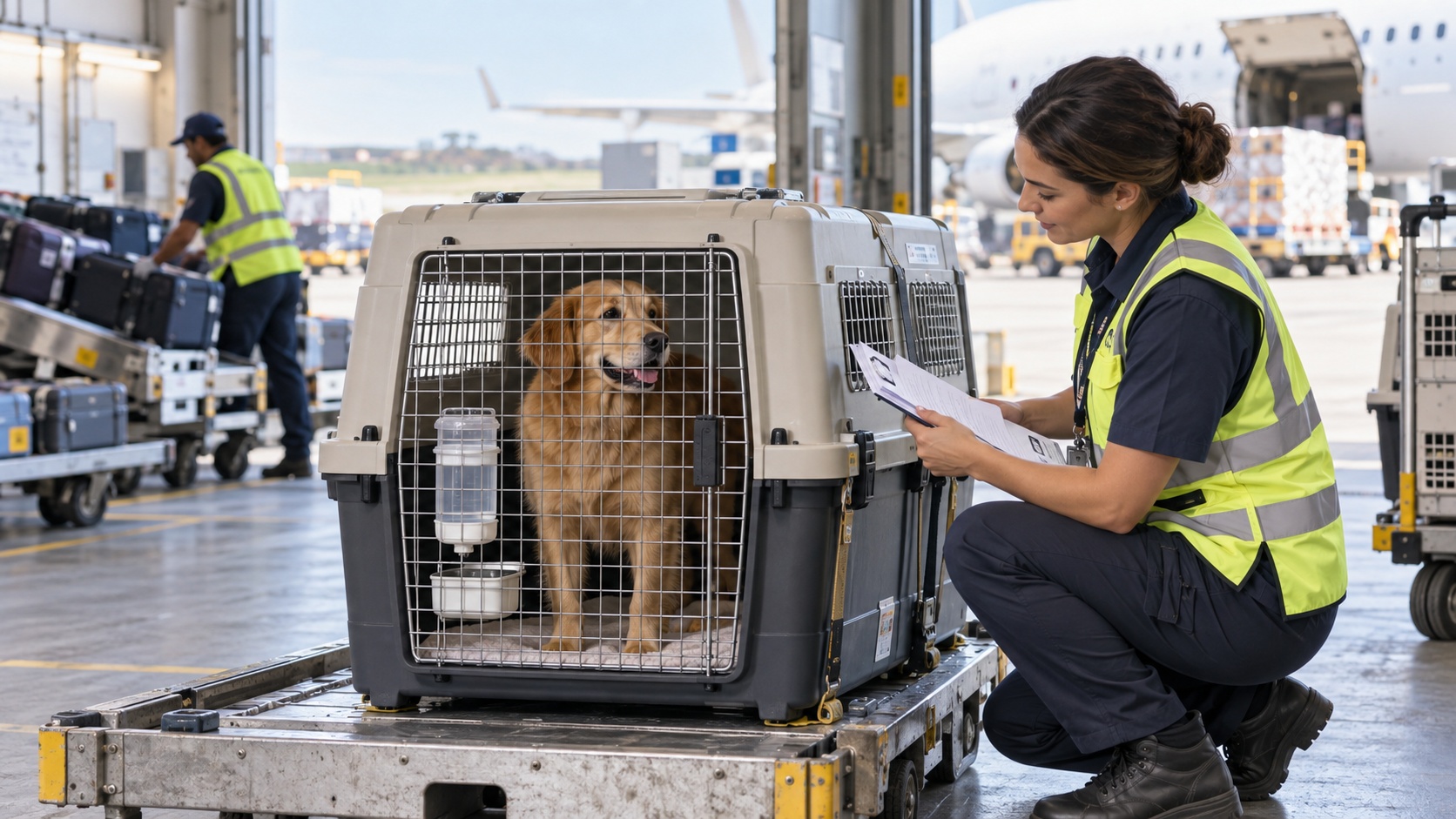
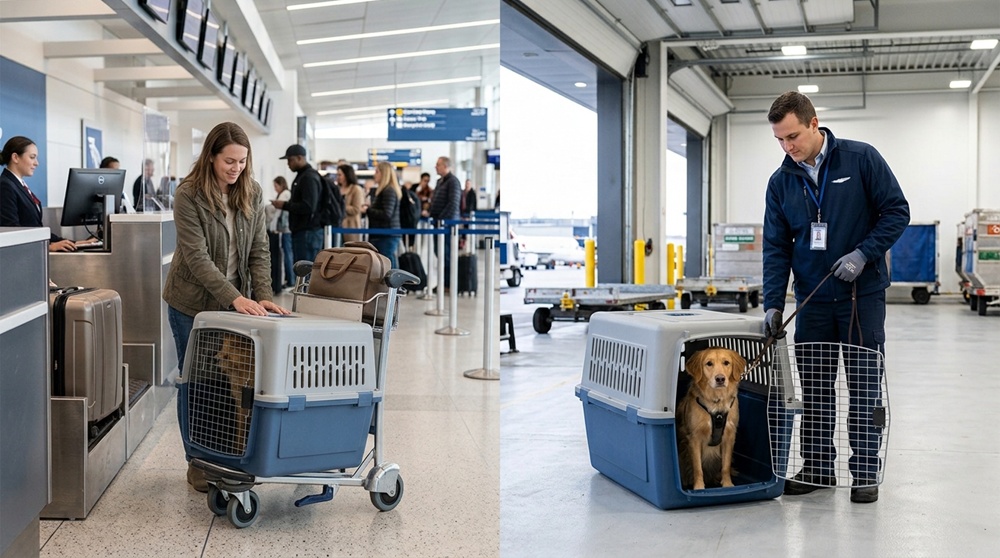
The appropriate travel method depends on the airline, route, pet, crate size and the import pathway. A dog or cat may travel as accompanied baggage where an airline offers that service, or as manifest cargo when required by the carrier, the animal's size or the itinerary.
Paws en route generally recommends the most direct and least complicated suitable route for the pet. This is particularly valuable for India because the chosen arrival airport must work with AQCS clearance, and adding an international transit point can introduce another airline's rules and additional live-animal handling.
A passenger flight being available does not mean the pet is accepted on the same service. Pet space, aircraft limitations, seasonal temperatures, breed restrictions and the operating carrier must all be confirmed separately.
Not sure which air travel option applies to your pet? Read our guide to the 3 types of international pet air travel.
There are nonstop passenger services between Canada and India, including Toronto–Delhi and Vancouver–Delhi options in current airline schedules. Direct availability varies by carrier and season, so the exact flight should be verified before the pet's documentation is finalized.
A nonstop itinerary can be especially useful for a pet because it avoids a foreign transit airport and reduces handling. However, the best route is the most direct suitable route that also accepts the individual animal and crate and arrives through an approved AQCS entry point.
Air India transports domestic dogs and cats through its pet program, but its current published policy says pets are not accepted in the cabin or as checked baggage on routes into or out of Canada. A Canada-to-India move on Air India therefore needs to be evaluated through the airline's cargo arrangements rather than assuming the passenger pet program applies.
Air India also states that an AQCS NOC or pre-import clearance is required for pets imported to India.
Air Canada currently sells Canada–India services, including Toronto and Vancouver to Delhi. Pet acceptance must be checked for the exact flight and travel method. Large pets, unaccompanied animals or itineraries that cannot use a passenger pet program may require cargo arrangements.
Connecting carriers can also be considered, but every operating airline and transit point must accept the pet. Paws en route generally favours a direct or simpler routing when it is suitable for the animal.
On arrival, the pet and original health documents are presented to AQCS for review and physical examination. The original health certificate is retained as part of the clearance process.
If the pet is healthy and the documentation is in order, AQCS can issue the applicable provisional or final clearance according to the import category and current procedure. Customs formalities may also need to be completed, particularly for a cargo shipment.
If documents are incomplete or the animal raises a health concern, AQCS can hold the pet for further observation, testing or other action. This is why the arrival plan should be coordinated before the flight departs Canada.
India's current AQCS FAQ says pets imported under the baggage rules are generally exempt from routine quarantine, although they can be quarantined when there is doubt about the animal's health or documentation.
AQCS's baggage guidance states that original documents are reviewed after arrival, provisional clearance can be issued, and final clearance follows the applicable post-arrival process. Older sanitary certificates contain different quarantine language, so travellers should follow the current AQCS NOC and instructions issued for their specific import rather than relying on an older generic certificate.
If the move is temporary, plan the return before leaving Canada. A pet taken from India and later returning under India's re-import pathway should retain proof of its earlier AQCS or government certification and travel history.
For entry back into Canada, the pet must meet the CFIA requirements in effect at the time of return. Those requirements depend on species, age, rabies status, country of origin and purpose of import.
Keep the microchip certificate, vaccination records, Indian AQCS paperwork and Canadian export records throughout the trip.
Two to four months before travel: Determine whether the pet qualifies under India's baggage rules, requires a DGFT licence or is a re-import. Confirm the intended AQCS port and a suitable flight route.
At least six to eight weeks before travel: Review the microchip and vaccination history. If rabies vaccination is needed, allow more than one month before embarkation and ensure it will meet India's validity requirement.
Several weeks before travel: If a DGFT licence or advance Customs permission is required, complete that process. Confirm airline or cargo acceptance and crate requirements.
Before the final NOC window: Prepare the official health certificate and supporting records, coordinate CFIA endorsement, and confirm the current submission instructions with the destination AQCS office.
Within the AQCS advance-clearance window: Submit the final documents for the advance NOC. Reconfirm the flight, airway bill where applicable and arrival arrangements.
On arrival: Present the pet and original documents for AQCS examination and complete the applicable quarantine and customs clearance process.
India's AQCS FAQ defines dogs and cats as the animals covered by the pet baggage category. A parrot, rabbit, hamster, fish or other animal cannot simply enter under the same personal-pet baggage rule.
AQCS directs importers of other animals to obtain the appropriate DGFT licence and comply with the sanitary conditions attached to that import. Wildlife or protected species can also involve additional Indian and international conservation requirements.
Paws en route can research the species-specific process and coordinate the applicable government, airline and routing requirements.
India is a destination where the regulatory pathway matters as much as the veterinary checklist. Paws en route can help determine whether the move fits the baggage rules, requires a DGFT licence or falls under the re-import process before the travel plan is built.
Support can include coordinating the AQCS advance NOC, reviewing veterinary and CFIA documentation, identifying the most direct and least complicated suitable route, arranging manifest cargo when required, planning the travel crate, and coordinating airport and destination handling.
For animals other than dogs and cats, Paws en route can research the appropriate licence and import conditions and help coordinate the move.
International pet travel is more than booking a flight. Learn more about why international pet travel requires careful planning.
No. The standard baggage pathway is for qualifying owners transferring residence to India after at least two years of continuous stay abroad, for up to two personal dogs or cats. Other situations may require a DGFT licence.
Up to two dogs or cats can qualify under the personal baggage pathway when the owner meets the applicable transfer-of-residence requirements.
Yes. AQCS states that the advance NOC is required before boarding. For baggage imports, it can be issued within seven days before arrival based on advance copies of the required documents.
Current AQCS dog and cat procedures include a microchip certificate among the supporting import documents. Use the same microchip number consistently throughout the travel file.
Under the published baggage requirements, dogs three months and older and cats must have rabies vaccination more than one month but within 12 months before embarkation.
No. AQCS currently lists Delhi, Mumbai, Chennai, Kolkata, Bengaluru and Hyderabad as pet entry ports. The port should match the AQCS clearance.
AQCS currently states that pets imported under the baggage rules are generally exempt from routine quarantine, although quarantine can be required if there is doubt about health or documentation.
Air India's current policy says pets are not accepted in the cabin or as checked baggage on routes into or out of Canada. Cargo arrangements need to be considered for that carrier.
A short visit does not normally fit the standard transfer-of-residence baggage pathway. AQCS directs movements outside that pathway to the DGFT licensing process unless another specific category, such as re-import, applies.
No. India's pet baggage category covers dogs and cats. Other species generally require a DGFT licence and species-specific import conditions.
Pet travel from Canada to India is manageable when the import category, AQCS clearance, veterinary documents and flight are planned as one process rather than as separate tasks.
Paws en route can support one stage of the move or coordinate a more complete relocation based on your pet, travel purpose, destination city and timeline.
Ready to travel?
Our IPATA-certified pet travel specialists help manage the details, from airline booking to health certificates and import permits, for a smoother travel experience.
Get a custom quotePaws en route provides trusted support for every step of pet travel, from complex international relocations to domestic travel within Canada.