

Table of Contents
Moving a pet from Canada to South Africa requires careful advance planning. Dogs and cats need a South African veterinary import permit, permanent microchip identification, rabies documentation and a country-specific veterinary health certificate completed in Canada and endorsed by the Canadian Food Inspection Agency (CFIA). Dogs have additional blood-testing and treatment requirements that make their preparation considerably more complex than the process for cats. Paws en route's international pet air travel and relocation services can help coordinate these steps as one travel plan rather than treating the permit, veterinary work and flight as separate tasks.
South Africa also requires dogs and cats arriving internationally to be handled as manifest cargo rather than as ordinary passenger baggage. There are currently no nonstop flights from Canada to South Africa, so routing is an important part of the planning process. The transit airport, operating airlines, live-animal handling arrangements and total journey time all need to work for the individual pet.
This guide focuses on dogs and cats travelling from Canada. Paws en route also works with other species, but reptiles, amphibians, birds, exotic animals and other pets can follow different South African permit and veterinary requirements.
Dogs and cats entering South Africa from Canada need a veterinary import permit issued by South Africa before travel. They must be permanently identified by microchip and meet the rabies requirements stated on the permit and Canadian export certificate. A licensed veterinarian in Canada completes the appropriate South Africa-specific CFIA certificate, which must then be endorsed by an official CFIA veterinarian before departure.
The process for dogs includes several additional disease tests and treatments. The current Canadian dog certificate requires negative testing within 30 days of import for Brucella canis, Trypanosoma evansi (surra), Babesia gibsoni, Dirofilaria immitis (heartworm) and leishmaniosis, using the specific test methods listed on the certificate. This is one of the main reasons a South Africa move should be started well before the intended flight.
| Requirement | Dogs | Cats |
|---|---|---|
| Veterinary import permit | Required before travel | Required before travel |
| Microchip | ISO 11784 or 11785 readable | ISO 11784 or 11785 readable |
| Rabies vaccination | Required (over 3 months) | Required (over 3 months) |
| Pre-import blood tests | Five tests within 30 days of import | Not required |
| Heartworm and parasite treatments | Required before and after travel | Not required |
| Clinical exam | Within 10 days of export | Within 10 days of export |
| CFIA-endorsed health certificate | HA2123 | HA2124 |
| How pets must fly | Manifest cargo | Manifest cargo |
| Routine quarantine | Not normally required if compliant | Not normally required if compliant |
A South African veterinary import permit must be obtained before the pet is shipped. South African government guidance advises applicants to apply in advance and notes that import conditions can change, so the permit issued for the individual pet should be treated as a key part of the travel file.
The permit application includes information about the animal, owner or importer, country of origin, destination and proposed movement. Proof of payment is required before the permit is processed. South African government guidance says that once an application has been approved, permit processing generally takes several working days, while South African consular guidance recommends applying at least four weeks before import.
CFIA specifically advises Canadian exporters to read the South African permit together with the Canadian export certificate because its web page is not an exhaustive statement of every condition. Requirements can change without advance notice to CFIA.
Dogs and cats must be permanently identified with a microchip. The current CFIA dog and cat certificates require the microchip number and location and state that the microchip must be readable by an ISO 11784 or ISO 11785 scanner.
The microchip should be scanned before the veterinary work begins, and the number should be checked carefully across the import permit, vaccination records, laboratory reports, health certificate and cargo booking. A mismatch in a microchip number can create a serious documentation problem on a move with this many linked records.
Dogs and cats over three months old require a valid rabies vaccination. Under the current Canadian certificates, a primary rabies vaccination must have been given at least 30 days, but not more than 12 months, before export. A booster must have been administered within the previous 12 months; the 30-day wait does not apply when the booster was given before the previous vaccination expired.
Animals under three months can qualify under a specific maternal-vaccination provision when the mother met the required rabies timing before giving birth. The young animal must then be vaccinated against rabies at three months of age after arrival in South Africa and the South African veterinary authorities must be informed.
The original or a copy of the rabies vaccination certificate must accompany the veterinary health certificate.
The dog import process is significantly more involved than the cat process. The current CFIA certificate requires dogs to test negative for five conditions within 30 days from the date the sample is collected to the date of import. The required diseases are Brucella canis, Trypanosoma evansi, Babesia gibsoni, Dirofilaria immitis and leishmaniosis. South Africa specifies the acceptable laboratory method for each test, so a negative result from a different testing method may not satisfy the certificate.
Trypanosoma evansi, also known as surra, deserves special attention for Canadian pet parents. CFIA states that the required testing is currently not available in Canada. International laboratories do offer the required testing, but the exporter is responsible for arranging it. This means sample handling, laboratory turnaround time and the 30-day import window need to be planned together.
Laboratory reports must be in English and accompany the veterinary health certificate. Because one delayed result can affect the entire travel calendar, Paws en route recommends confirming laboratory availability before finalizing the flight.
After a negative Dirofilaria immitis test, the dog must remain on one of the heartworm preventive treatments specified on the current CFIA certificate at the required interval until export. The certificate also requires this treatment to continue for six months after arrival in South Africa, and the veterinarian must confirm that the owner has enough of the medication to continue the required therapy.
The certificate includes one exception: if the negative Dirofilaria immitis test was performed within 11 months of a ProHeart SR-12 injection, no further heartworm treatment is required. Your veterinarian can confirm whether this applies to your dog.
Dogs must also be treated with an effective acaricide and insect repellent registered in Canada within 30 days before departure for the leishmaniosis and Babesia gibsoni risk. Product, dosage and treatment dates are recorded on the export certificate.
These are not generic recommendations that should be substituted with whatever parasite product a pet already uses. The treatment schedule should be built directly from the current CFIA certificate and the conditions on the South African import permit.
Canada has specific export certificates for dogs (HA2123) and cats (HA2124) travelling to South Africa. CFIA instructs Canadian exporters not to use the specimen veterinary certificate that may arrive with the South African permit. Instead, the appropriate Canadian certificate should be used and printed on legal-size paper.
A licensed Canadian veterinarian completes and signs the certificate after confirming that the animal meets the applicable health requirements. Both dogs and cats must undergo a clinical examination within 10 days of export and be found free of internal and external parasites, contagious and infectious disease and fit to travel.
The completed certificate must then be reviewed and endorsed by an official CFIA veterinarian before the pet leaves Canada. The CFIA appointment should include the South African import permit, laboratory reports, rabies certificate, treatment records and any other supporting documents. CFIA cannot endorse the export certificate after the animal has departed Canada.
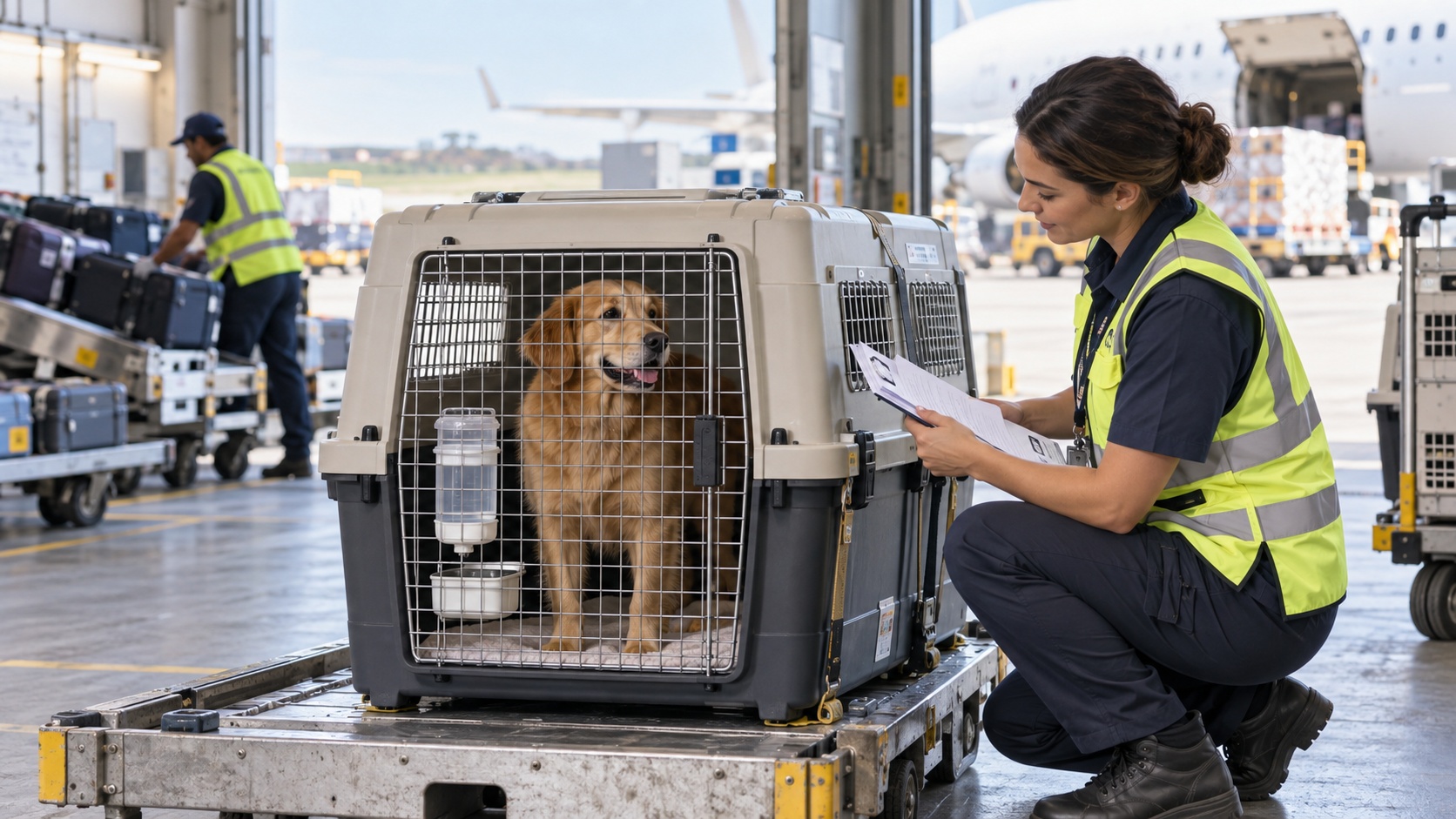
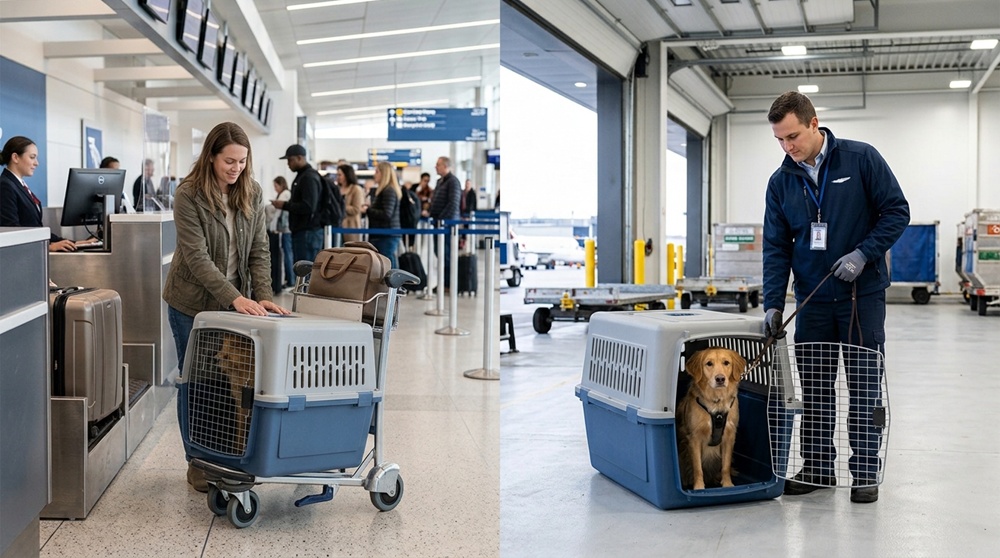
Dogs and cats arriving in South Africa on international flights must travel as manifest cargo rather than as excess or checked baggage. South African Airways' current international pet guidance states that animals travelling to and from South Africa must be transported as manifested cargo under an air waybill. This makes South Africa a particularly good example of why it is important to understand the difference between pet cargo and checked baggage.
Manifest cargo is a separate live-animal shipment with specialized booking, documentation and handling procedures. If the terminology is unfamiliar, Paws en route also explains the three types of international pet air travel and how cabin, baggage and manifest-cargo arrangements differ.
The pet parent can still travel on a passenger itinerary, but the pet's booking is handled separately through the airline's cargo operation. Depending on the route, a professional pet shipper or cargo agent may be required to make the booking and coordinate the transfer.
There are currently no nonstop passenger flights from Canada to Johannesburg or Cape Town, so a Canada-to-South Africa pet journey requires at least one international connection. Passenger booking sites may display an Air Canada itinerary from Toronto or other Canadian cities to South Africa, but these are connecting journeys rather than nonstop Air Canada-operated services.
For pets, the passenger itinerary is not the deciding factor. The cargo route must be confirmed independently, including whether each airline accepts live animals, whether the transfer airport can handle a live-animal transshipment, whether the crate can be accommodated on every aircraft and whether the connection provides appropriate care and holding arrangements.
Paws en route generally recommends the most direct and least complicated suitable route for the individual pet. On a long journey to South Africa, one well-planned connection can be preferable to a lower-cost itinerary involving multiple airlines, terminals or transfers.
A connection is more than a passenger layover when a pet travels as manifest cargo. The cargo shipment may need to be transferred between flights, and the transit airport and airline need procedures for handling live animals during the connection.
When evaluating a route, Paws en route considers total journey time, connection length, weather, aircraft type, crate size, airline live-animal policies, cargo handling facilities and whether the pet remains under one carrier's control or needs an interline transfer. Transit-country rules can also matter depending on how the shipment is handled.
This is one of the areas where a full-service international pet relocation plan can reduce complexity. The best passenger fare is not necessarily the best pet itinerary.
Dogs and cats must travel in containers that conform to IATA requirements. The current Canadian certificates state that the container must be new or suitably disinfected and fumigated before loading and designed to prevent contact with animals of a lower health status while en route. The kennel must also be appropriately sized for the individual pet. For more detail, see Paws en route's Airline-Approved Pet Carriers: The Ultimate Guide.
The pet should be able to stand naturally, turn around and lie down comfortably. Ventilation, door construction, hardware, water containers and any airline-specific modifications need to be confirmed before the cargo booking is finalized. Large dogs can require oversized kennels that restrict which aircraft and routes are available.
Crate familiarization should start well before departure so the kennel is a familiar resting space rather than something introduced on travel day. Paws en route's pre-travel preparation guidance includes practical crate-acclimation advice.
On arrival, the pet enters through the cargo terminal and the original veterinary documentation is reviewed by South African veterinary import officials. The travel file should include the original veterinary import permit, the original CFIA-endorsed veterinary health certificate, rabies documentation and any other records required by the permit, including laboratory reports for dogs.
Once the veterinary requirements and cargo or customs formalities are completed, a compliant pet can be released. If documentation does not meet the permit conditions, South African authorities can delay release, quarantine the animal, require further testing or take other action under the import rules.
Because the pet is arriving as cargo, destination handling should be planned before departure. Paws en route can work with destination partners to coordinate veterinary clearance, cargo release and onward transportation to the pet's final destination.
Cats are not routinely quarantined when they arrive with compliant documentation. Dogs from Canada are also on South Africa's list of origins that are not normally subject to routine post-arrival quarantine. That does not mean quarantine is impossible.
A dog or cat can be detained when original documents are missing or the veterinary conditions have not been met, and the current Canadian dog certificate notes that animals subjected to post-import quarantine may be retested at the importer's expense. The safest wording for planning purposes is therefore that routine quarantine is not normally required for a compliant dog or cat travelling from Canada, but South African veterinary authorities retain the ability to quarantine an animal when necessary.
If the move is temporary, plan the return before the pet leaves Canada. Canadian import requirements apply when a pet returns from South Africa and can vary according to species, age, rabies status, ownership and the purpose of entry.
Keep the pet's microchip, vaccination, South African import, CFIA export and laboratory records throughout the stay. A pet that later travels to another country may also benefit from having a complete record of its South Africa testing and treatment history.
The requirements above apply specifically to dogs and cats. South Africa requires veterinary import permits for live animals more broadly, and some species can also require additional animal-improvement, quarantine, conservation or CITES approvals.
CFIA currently publishes a South Africa-specific export certificate for reptiles and amphibians, while other species may require a different certificate or a process developed around the South African import permit. The species, scientific name, purpose of travel, origin and proposed route should be reviewed before transportation is booked.
Paws en route works with animals beyond dogs and cats and can research the species-specific process as part of its international pet air travel services.
South Africa is a destination where the details need to be coordinated in the correct order. Paws en route can help with the import-permit process, veterinary timeline, laboratory planning, CFIA documentation, crate requirements, cargo booking, transit routing and destination handling through its international pet relocation service.
For dogs, one of the most important planning issues is arranging the required blood tests within the correct window, particularly the Trypanosoma evansi testing that CFIA says is not currently available in Canada. Paws can help build the timeline around laboratory availability and the intended arrival date.
Because South Africa requires manifest cargo, Paws can also coordinate the live-animal air shipment and help pet parents understand what the additional cargo handling provides. Read Pet Cargo vs. Checked Baggage: What's the Difference? for more on how the two services differ.
Support can extend to airport transportation, cargo check-in, destination clearance and onward delivery. See Paws en route's pet air transportation services for an overview of the services available.
Yes. A South African veterinary import permit must be obtained before the animal is shipped. The issued permit should be reviewed together with the current CFIA certificate because South African requirements can change.
Yes. The current Canadian dog and cat certificates require permanent microchip identification, and the microchip must be readable by an ISO 11784 or ISO 11785 scanner.
Yes, subject to the specific provisions for very young animals. For a primary vaccination, the current certificate requires vaccination at least 30 days but not more than 12 months before export. A qualifying booster must have been given within the previous 12 months.
The current CFIA dog certificate requires negative testing within 30 days of import for Brucella canis, Trypanosoma evansi, Babesia gibsoni, Dirofilaria immitis and leishmaniosis using the test methods specified on the certificate.
CFIA states that the required Trypanosoma evansi testing is currently not available in Canada. The exporter must arrange testing through an international laboratory that can perform the required methods.
No. The current CFIA cat certificate does not contain the five pre-import disease tests required on the dog certificate. Cats still need the import permit, microchip, rabies compliance, clinical examination and CFIA-endorsed health certificate.
No under the current international arrival process. Dogs and cats entering South Africa by air are handled as manifest cargo and arrive through the cargo terminal.
There are currently no nonstop flights from Canada to Johannesburg or Cape Town. A pet itinerary therefore requires at least one connection, and the cargo routing needs to be confirmed independently from the pet parent's passenger itinerary.
Routine quarantine is not normally required for a compliant cat or a dog arriving from Canada. However, South African authorities can quarantine or detain an animal when documentation or health requirements are not met.
For a dog, starting three to four months ahead is sensible because of the import permit, cargo routing, laboratory availability and strict 30-day testing window. Cats have fewer testing requirements, but advance planning is still recommended.
Pet travel from Canada to South Africa is achievable, but it is not a journey to organize at the last minute. The import permit, microchip, rabies history, veterinary certificate, dog testing where applicable, CFIA endorsement, manifest-cargo booking and international connection all need to align.
Paws en route can support a specific part of the process or coordinate a more complete relocation from Canada through arrival in South Africa. Request information about international pet travel and relocation to build a plan around your pet, departure city, destination and timeline.
Ready to travel?
Our IPATA-certified pet travel specialists help manage the details, from airline booking to health certificates and import permits, for a smoother travel experience.
Get a custom quotePaws en route provides trusted support for every step of pet travel, from complex international relocations to domestic travel within Canada.