Table of Contents
Travelling with a dog or cat from Canada to Australia requires more preparation than most international pet journeys. Australia's strict biosecurity system is designed to prevent animal diseases and parasites from entering the country, so the process involves carefully sequenced veterinary work, government approvals, cargo flight arrangements and post-arrival quarantine.
Canada is an approved Group 3 country for importing dogs and cats into Australia. Most eligible pets can travel, but owners should generally begin planning at least six months before departure. Allowing seven to nine months is often more realistic, especially when coordinating the rabies titre test, import permit, quarantine reservation and flight availability.
One of the most important decisions must be made near the beginning of the process. When the optional government identity verification is completed before the rabies titre blood sample, an eligible pet may qualify for a minimum 10-day quarantine stay instead of the standard minimum of 30 days.
This guide explains the main requirements for moving a dog or cat from Canada to Australia and where specialized support can help.
| Requirement | Summary |
|---|---|
| Country classification | Canada is an approved Group 3 country |
| Recommended planning period | At least 6 months; often 7-9 months |
| Import permit | Required |
| Microchip | Required and must match every document |
| Rabies vaccination | Required and must remain continuously valid |
| Rabies titre test | Required |
| Government identity verification | Optional, but may reduce quarantine |
| CFIA endorsement | Required before departure |
| How pets travel | Manifest cargo |
| Australian arrival airport | Melbourne International Airport |
| Quarantine location | Mickleham Post Entry Quarantine Facility |
| Typical quarantine | Minimum 30 days, or potentially 10 days with qualifying identity verification |
These are general requirements. The exact process can differ according to the pet's species, age, vaccination history, reproductive status, countries previously visited and the conditions stated on the Australian import permit.
The Australian process is not simply a list of documents to collect. It is a sequence in which one step can affect several later steps.
For example, the microchip must be verified before the rabies titre blood sample. Rabies vaccination must remain valid throughout the process. The blood sample must reach the approved laboratory at least 180 days before export. The import permit, quarantine reservation, final treatments, health certificate and flight must then be coordinated within their respective validity periods.
An error early in the process may not become apparent until months later. A missing microchip number on a laboratory report, an expired rabies vaccination or a treatment given outside its required window can delay departure or affect quarantine eligibility.
That is why Australia is best approached as a single coordinated travel plan rather than a collection of separate veterinary, documentation and airline tasks.
Most eligible domestic dogs and cats can be imported from Canada when they satisfy Australia's Group 3 conditions.
The pet must generally:
Certain dog breeds, wolf-dog hybrids, wild-cat hybrids and other non-domestic animals are prohibited. Pregnancy, nursing status, current quarantine restrictions and previous travel history may also affect eligibility.
The Australian process has a built-in waiting period tied to the rabies neutralising antibody titre test, commonly called the RNATT.
The RNATT sample must reach the testing laboratory at least 180 days before the pet can be exported. This makes six months the practical minimum even when every earlier step is completed correctly.
A safer planning period is usually seven to nine months, allowing time for:
Pets with complex medical, breed or travel histories may require longer.
Before beginning veterinary work, confirm that the animal can legally be imported. Australia's requirements consider more than the pet's current Canadian address.
Important factors can include:
A full travel-history review is particularly important for dogs because previous residence or travel in certain countries can trigger additional tests, treatments or declarations.
Australia uses the microchip as the pet's official identity throughout the import process. The chip must be readable and its number must appear consistently on vaccination records, laboratory submissions and results, veterinary treatment records, the import permit application, the Australian health certificate and all CFIA-endorsed supporting documents.
Generally, compliant 10- or 15-digit microchips are accepted. Australian guidance states that microchips beginning with 999 are not accepted.
The microchip should be scanned at every relevant veterinary appointment and before each blood sample is collected. Australia may reject laboratory documentation containing a missing or incorrect microchip number, and the laboratory report may not simply be amended later to repair the discrepancy.
Confirm the chip before starting the rabies process, even when the pet has had the same microchip for years.
This is one of the most important planning decisions in an Australia-bound pet journey.
Canada participates in Australia's optional Identification Declaration process. Under this process, an authorized CFIA official scans and verifies the pet's microchip before the blood sample for the RNATT is collected.
When the declaration and the rest of the import process are completed correctly, the pet may qualify for a minimum 10-day post-entry quarantine stay rather than the standard minimum of 30 days.
The order matters:
Completing an ordinary microchip scan at a private veterinary clinic is not the same as completing Australia's qualifying government identity process. Once the blood has already been drawn, it may be too late to use that result for the reduced quarantine pathway.
The pet's rabies vaccination must be valid when the titre sample is collected and remain continuously valid through export. When the pet is receiving a primary rabies vaccination, the RNATT is generally completed at least three to four weeks later. A pet already maintained on a valid booster schedule may follow a different sequence, depending on its records.
Avoid allowing the vaccination to expire while the import process is underway. A lapse can disrupt the titre and permit timeline.
Australia accepts approved FAVN or RFFIT testing methods. The result must be at least 0.5 IU/mL.
Two different dates matter: the date the blood sample is collected and the date the sample arrives at the approved laboratory.
The sample must arrive at the laboratory at least 180 days before export. The RNATT remains valid for 12 months from blood collection, provided the rabies vaccination remains continuously valid. This creates a limited travel window: the pet cannot leave before the 180-day requirement has been completed, but it must also travel before the test and related permit expire.
A valid import permit is required before the pet travels. The application relies on information and supporting documents generated earlier in the process, including the pet's microchip, rabies records, RNATT result and, where used, the official identity declaration.
Permit conditions become the controlling instructions for the shipment. Veterinary work, documentation, quarantine and the travel date should all be checked against the permit issued for that specific pet.
Do not assume that receiving the permit means the pet is ready to fly. Quarantine availability and flight planning must also be considered while the application is underway.
The final weeks before travel involve tightly timed veterinary work.
The second internal parasite treatment is generally administered within five days of export.
Dogs complete the core requirements above but may also require testing or treatment relating to Brucella canis, Leishmania infantum, Leptospira interrogans serovar Canicola and Babesia species.
Whether every requirement applies can depend on the dog's travel history, reproductive status, prior diagnoses and countries visited. For example, previous travel to mainland Africa can trigger additional Babesia-related requirements.
Many dog-specific tests fall within the final 45 days before export. Because several tasks overlap, the final veterinary phase should be placed on a day-by-day calendar using the current permit and certificate instructions.
The final pre-export veterinary examination generally takes place within five days before export.
During the final examination, the veterinarian confirms that the pet is fit to travel and checks for signs of infectious or contagious disease and external parasites. The required Australian veterinary certificate and supporting documents must then be reviewed and endorsed by CFIA.
CFIA requires an appointment and recommends providing as much advance notice as possible. Government endorsement must be completed before the pet leaves Canada. It cannot be added afterward.
Every microchip number, date, product, test result, signature and endorsement should be checked before the pet is presented to the airline.
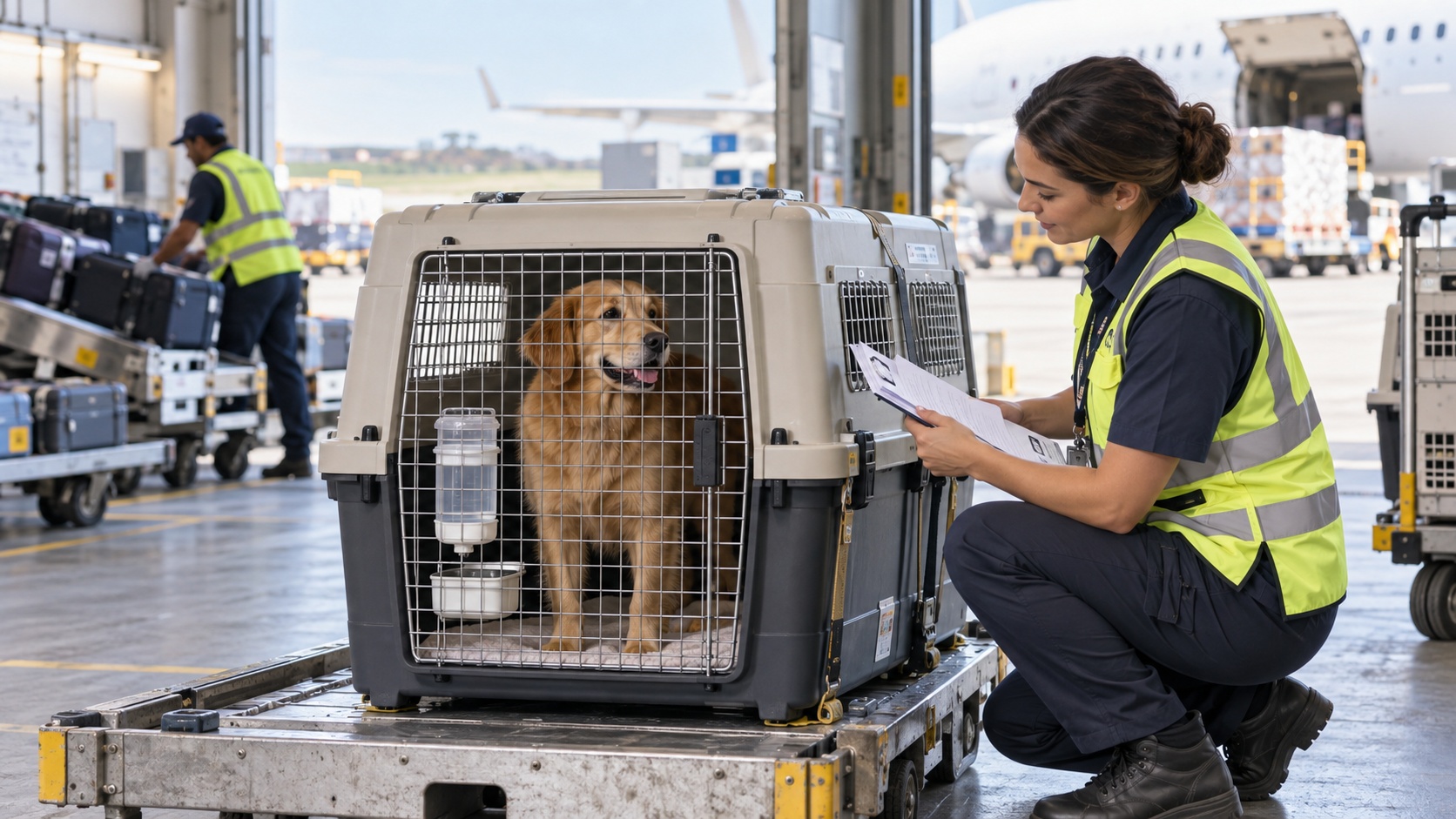
Dogs and cats entering Australia through the standard import process must travel as manifest cargo. They cannot enter Australia in the passenger cabin, as ordinary checked baggage or through a different Australian airport followed by a domestic flight to Melbourne.
Eligible assistance dogs may be subject to different provisions, but these do not apply to ordinary companion animals.
Manifest cargo means the pet is booked under an air waybill and handled through the airline's live-animal cargo system. Depending on the airline, bookings may need to be made through a professional pet shipper or IPATA member rather than directly by the owner.
Australia requires the pet's final international flight to arrive at Melbourne International Airport. The pet cannot first land in Sydney, Brisbane or another Australian city and then take an Australian domestic flight to quarantine.
In many cases, there may not be a suitable direct pet cargo route from the pet's Canadian departure city to Australia. The journey may therefore involve ground transportation to a Canadian departure airport, followed by a flight to a major U.S. gateway such as Los Angeles (LAX), where the pet connects to an Australia-bound cargo flight. Depending on the route and airline, other gateway cities may also be considered.
The best route depends on the Canadian departure city, the pet's size and breed, crate dimensions, aircraft type, seasonal heat restrictions, transfer facilities, transit-country rules and quarantine admission timing.
Choosing the right route to Australia can be complex, especially when ground transportation, flight connections and pet cargo requirements are involved. Contact Paws en route, and our team can help identify a suitable route and coordinate the travel details around your pet's veterinary and quarantine timeline.
Pets travelling to Australia need a secure, appropriately sized crate that complies with current IATA Live Animals Regulations and airline requirements.
The pet should be able to stand without touching the top of the crate, sit naturally, turn around comfortably and lie down in a normal position.
The crate may also need secure metal hardware, ventilation on the required sides, attached food and water containers, an absorbent floor lining, exterior identification and document pouches, and breed-appropriate construction or reinforcement.
Large dogs and certain breeds may require custom wooden crates. Crate measurements should be confirmed before requesting a flight quote because external dimensions affect aircraft compatibility, cargo pricing and routing options.
Related Paws resource: Preparing Your Pet for Air Travel: 5 Tips for a Smoother Journey
After arrival at Melbourne International Airport, the pet is transferred through the designated biosecurity process to the Mickleham Post Entry Quarantine Facility near Melbourne. Owners do not collect their pets directly from the passenger terminal.
Most dogs and cats entering Australia from Canada complete either a minimum 30-day quarantine stay or a minimum 10-day stay when the qualifying official identity verification was completed before RNATT collection and the supporting documents are accepted.
The shorter period is not automatic. A minimum stay can become longer when documents do not match, additional testing is required, parasites or signs of illness are identified, veterinary care is needed, release conditions have not been satisfied or fees remain unpaid.
After release, owners can arrange onward ground or domestic air travel to another Australian city.
Australia prohibits the import of certain dog breeds and non-domestic hybrids.
Prohibited dog breeds include:
Prohibited dog hybrids include certain wolf-dog types, such as Czechoslovakian Wolfdog or Vlcak, Saarloos Wolfdog, Lupo Italiano and Kunming Wolfdog.
Restricted cat hybrids include Savannah, Safari, Chausie and Bengal cats. Bengal cats are no longer permitted for import from March 1, 2026.
Breed names on veterinary, registration and ownership records should be reviewed early. Do not book travel for a potentially restricted breed or hybrid until eligibility has been confirmed.
Avoid these common mistakes:
Australia is one of the most timing-sensitive pet travel destinations. Paws en route helps coordinate the documentation, veterinary timeline and flight plan so that each stage supports the next.
Rather than selecting an airline first and trying to make the documentation fit afterward, Paws en route builds the route and compliance plan together. The goal is the most direct, least complicated suitable journey for the pet.
The process requires a minimum period of approximately six months because the RNATT sample must reach the laboratory at least 180 days before export. Starting seven to nine months ahead is generally safer.
No. Ordinary pet dogs and cats must arrive as manifest cargo. Separate provisions may apply to eligible assistance dogs.
Yes. Dogs and cats generally complete a minimum 30-day quarantine stay. Eligible pets may qualify for a minimum 10-day stay when the approved official identity verification was completed before RNATT blood collection.
No. The standard Group 3 import process from Canada includes post-entry quarantine.
Imported dogs and cats quarantine at the Mickleham Post Entry Quarantine Facility near Melbourne.
Not under the standard Canada-to-Australia import pathway. The pet's final international flight must arrive at Melbourne International Airport.
Yes. A valid Australian import permit is required before travel.
The RNATT is a rabies neutralising antibody titre test used to confirm that the pet has produced an acceptable immune response to rabies vaccination. Australia requires an approved result of at least 0.5 IU/mL.
It is counted from when the RNATT sample reaches the approved laboratory, not simply from the vaccination date or the date the blood was drawn.
Possibly, but airline acceptance is more restricted. Breed, health, temperature, aircraft type, crate design and route must all be assessed before booking.
Often yes, but the transit airport, airline transfer process and local biosecurity conditions must be checked. The final international flight must still arrive directly into Melbourne.
Owners can complete parts of the process themselves, but manifest-cargo bookings may need to be arranged through an approved pet shipper or IPATA member, depending on the airline. Professional coordination is particularly valuable because the veterinary, permit, quarantine and flight timelines are closely connected.
Travelling with a pet from Canada to Australia is possible, but success depends on starting early and completing each step in the correct order.
Paws en route can support one part of the process or coordinate the complete journey, including documentation, import permits, veterinary timelines, crate planning, cargo booking, ground transportation, quarantine arrangements and arrival support.
Planning a move to Australia? Request a custom pet travel quote and let us help build a compliant travel plan around your pet, route and timeline.
Ready to travel?
Our IPATA-certified pet travel specialists help manage the details, from airline booking to health certificates and import permits, for a smoother travel experience.
Get a custom quotePaws en route provides trusted support for every step of pet travel, from complex international relocations to domestic travel within Canada.