Travelling or relocating a pet from Canada to Dubai requires careful coordination between United Arab Emirates import rules, Canadian veterinary documentation and the airline transporting your pet.
For dogs and cats, the process includes a UAE import permit, permanent microchip identification, required vaccinations, a rabies antibody titre test, parasite treatment and a veterinary health certificate endorsed by the Canadian Food Inspection Agency, or CFIA.
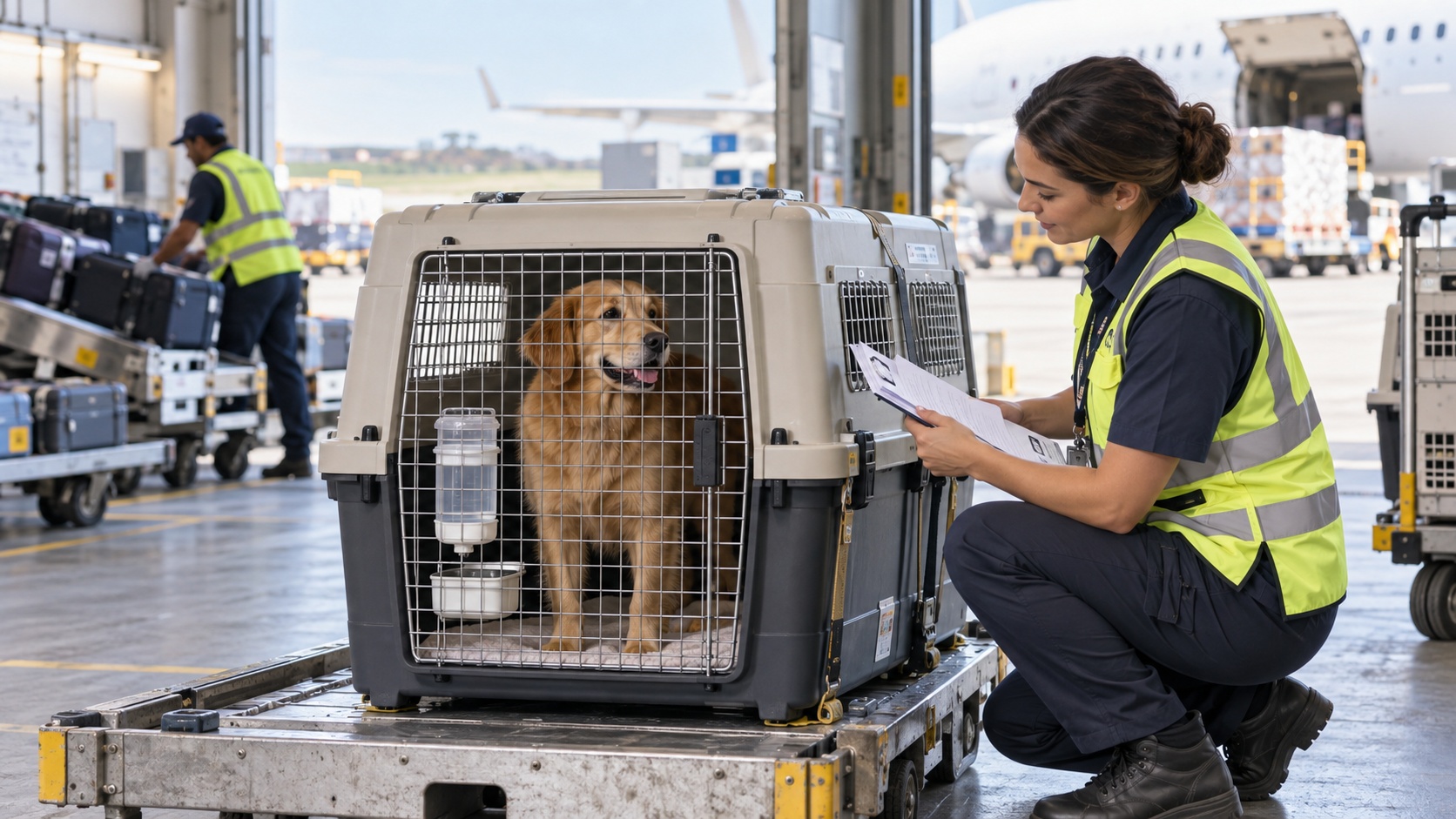
The flight must also be planned around the airline’s live-animal policy. Pets travelling to Dubai on Emirates must arrive as manifest cargo, which means their reservation, check-in and arrival clearance are handled separately from the owner’s passenger ticket.
This guide focuses on dogs and cats travelling from Canada to Dubai. Paws en route works with many types of animals, but birds, rabbits, reptiles, exotic animals and other species may be subject to different permits, veterinary certificates or wildlife requirements.
Dogs and cats travelling from Canada to Dubai must meet the federal import requirements established by the UAE Ministry of Climate Change and Environment. The process generally requires an advance import permit, a permanent microchip, current rabies and core vaccinations, a qualifying rabies antibody titre test, parasite treatment, a veterinary examination and a valid original UAE veterinary health certificate endorsed by CFIA.
The UAE allows an individual to import a maximum of two personal pets per year. This can be two dogs, two cats, or one dog and one cat.
A veterinary import permit must be obtained from the UAE Ministry of Climate Change and Environment before the pet travels. The permit is valid for 90 days from the date it is issued. It must still be valid when the animal arrives, so it should not be obtained so early that it expires before the planned journey. The details on the permit should match the pet’s other documents, including the owner or consignee information, animal description, microchip number, destination and port of entry.
CFIA advises travellers to compare the current UAE import permit with the Canadian export certificate before the veterinary certificate is completed. UAE requirements can change, and the permit issued for the specific journey should be treated as an important source of current instructions.
Every dog and cat must be identified with a permanent microchip. The microchip number must appear consistently on the import permit, vaccination records, rabies titre laboratory report and veterinary health certificate. The pet presented for inspection must match the identification number recorded in the documents.
Ideally, the microchip should be implanted and scanned before the vaccinations and blood test used for the journey. This helps establish that all records belong to the same animal.
The current CFIA certificate for dogs and cats travelling from Canada states that the minimum age for import into the UAE is 15 weeks. The pet must also have been at least 12 weeks old when vaccinated against rabies.
In practice, some pets may need to be older than 15 weeks before they can travel because enough time must be allowed for the rabies vaccination, the required waiting period, blood collection, laboratory processing and final documentation.
Airlines can also impose a higher minimum age than the destination country.
The pet must have a valid rabies vaccination administered according to the vaccine manufacturer’s instructions. The animal must have been at least 12 weeks old at the time of vaccination, and the vaccine must have been administered at least 21 days before departure. It must remain valid when the pet arrives in the UAE.
The vaccination record should clearly show the microchip number, vaccination date, vaccine name, manufacturer and batch number. Allow additional planning time when the rabies vaccination is the pet’s first dose or when a previous vaccination has expired.
Dogs and cats travelling from Canada require a rabies neutralizing antibody titre test under the current CFIA export certificate. The test must be performed by a laboratory approved by the competent authority, and the result must be at least 0.5 IU/mL. The test must have been completed within 365 days of the pet’s arrival in the UAE, and the rabies vaccination associated with the test must remain valid at entry.
When the rabies vaccination is the animal’s first vaccination, or when it was administered after the previous vaccine expired, blood cannot be collected until at least 21 days after vaccination.
When the vaccination is a booster administered while the previous vaccine was still valid, the UAE certificate does not require an additional 21-day wait before the blood sample is collected. The laboratory report should identify the animal by its microchip number and include the blood-collection date, testing method and result.
In addition to rabies vaccination, dogs must have current vaccinations against canine distemper, canine parvovirus, infectious canine hepatitis and leptospirosis. The UAE requirements identify the leptospirosis strains Icterohaemorrhagiae and Canicola. Vaccination details must be recorded on the veterinary certificate.
Cats must have current vaccinations against feline panleukopenia, feline rhinotracheitis and feline calicivirus, in addition to rabies vaccination. The vaccination documentation should include the microchip number, vaccination date, vaccine type, product or manufacturer and batch information.
The pet must be treated for both internal and external parasites within the 14 days before export. The treatment must use products approved for use in Canada. The veterinary certificate records the treatment dates, product names, manufacturers and active ingredients, so these details should be documented when the products are administered.
Because the treatment window is linked to the export date, it should be coordinated with the final veterinary examination and flight schedule.
A licensed veterinarian must clinically examine the pet within the five days before departure and confirm that the animal shows no signs of disease. The veterinarian completes the original CFIA form HA2839, Veterinary Health Certificate for Export of Dogs and Cats to United Arab Emirates. The completed certificate must then be endorsed by an official CFIA veterinarian before the animal leaves Canada.
The health certificate is valid for 10 days from its date of issuance. This creates a relatively tight final timeline. The private veterinary appointment, parasite treatments, CFIA endorsement, cargo document submission and flight date need to be coordinated so that every requirement remains within its permitted window.
The UAE may change its conditions without notifying CFIA immediately. Before the certificate is finalized, confirm that its requirements match the current import permit issued for the pet.
There are several nonstop passenger routes between Canada and the UAE.
Emirates operates direct service from Toronto to Dubai and Montréal to Dubai. Air Canada also operates year-round nonstop service between Toronto and Dubai. Etihad Airways flies directly between Toronto and Abu Dhabi. Airline schedules can change by season and operating conditions, so the selected flight should be confirmed before finalizing the pet’s documentation.
A nonstop passenger route does not automatically mean the airline will accept the pet on that flight. Pet availability depends on the airline’s policy, aircraft, cargo capacity, crate dimensions, breed, weather and handling arrangements.
The three common forms of air travel for pets are cabin travel, accompanied baggage in the aircraft hold and manifest cargo. However, not every option is available on every airline or route.
Emirates does not permit pets in the passenger cabin on ordinary flights. Most importantly for this route, Emirates states that animals on itineraries ending in Dubai must travel as cargo.
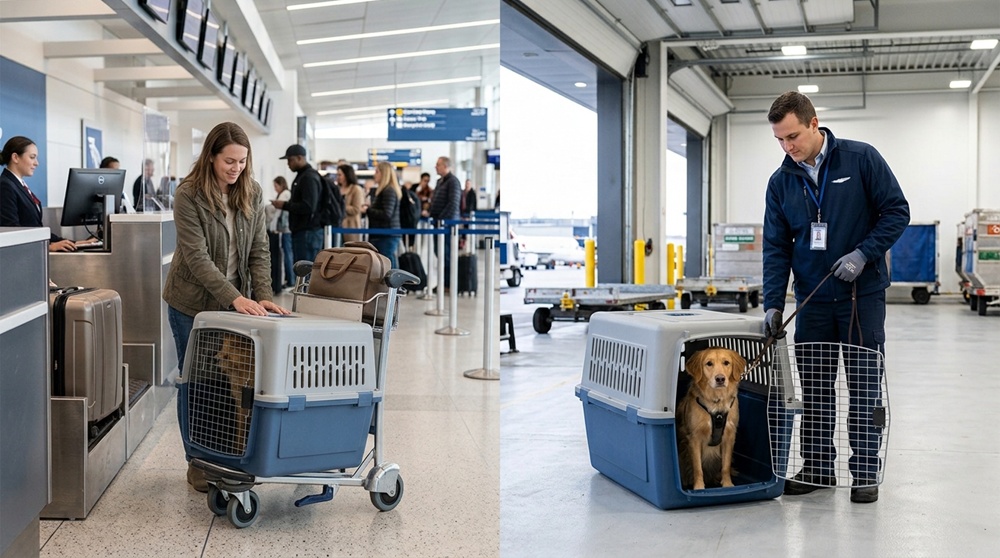
A manifest-cargo booking is separate from the owner’s passenger reservation. The pet travels under an air waybill and is accepted through the airline’s cargo facility rather than at the passenger baggage counter.
The process generally involves cargo booking, advance review of the veterinary and import documents, live-animal acceptance procedures, an IATA-compliant crate and destination clearance after arrival. Emirates advises contacting the airline well in advance and submitting the completed paperwork at least one week before the flight.
Air Canada operates a nonstop passenger route between Toronto and Dubai. Whether a pet can use that flight must be confirmed separately based on the animal, travel method, aircraft and current live-animal acceptance policies.
A passenger ticket should not be purchased on the assumption that a pet reservation will automatically be available. Large animals, unaccompanied pets or animals that cannot be accepted through the passenger program may require cargo arrangements.
Etihad operates nonstop flights between Toronto and Abu Dhabi and permits eligible small dogs and cats in the passenger cabin on approved Etihad-operated routes. Etihad requires advance application and documentation. Travellers flying to Abu Dhabi must also arrange the applicable UAE release procedures and health documentation.
An Abu Dhabi arrival is not the same as a Dubai arrival. Families relocating to Dubai would also need a suitable plan for clearing the pet in Abu Dhabi and travelling onward by ground.
A direct flight is often preferable for a pet because it reduces transfers, handling points and the possibility of a missed connection. However, the shortest passenger itinerary is not always the best available pet itinerary. The route must also work for the pet’s crate size, breed, operating aircraft and airline cargo program.
When a connection is necessary, the transit airport and airline must accept live animals. The pet must also meet any transit-country documentation requirements.
UAE rules state that dogs and cats should be shipped directly from the exporting country. When they transit through another country, they must not mix with other animals during the journey. The Canadian health certificate includes an owner declaration for routes that cross another country before reaching the UAE. Whenever possible, routing should be confirmed before the final veterinary paperwork is completed.
The UAE does not permit the importation of certain dog breeds. The current CFIA certificate lists:
Breed and crossbreed status should be reviewed before making flight arrangements. Airlines may also refuse additional breeds or require reinforced crates even when the UAE does not prohibit them.
The UAE publishes limited exceptions for qualifying service, emotional-support or medical-purpose dogs, subject to additional documentation and approval. These exceptions should be confirmed directly with the UAE authority before relying on them.
Bengal and serval cats must be accompanied by a pedigree certificate showing that they are at least a fifth-generation cross. Hybrid cats may also be subject to airline restrictions, CITES requirements or other wildlife rules. Their eligibility should be confirmed before the travel route is selected.
Brachycephalic, or flat-faced, dogs and cats can face additional airline restrictions because they are more vulnerable to respiratory difficulty and heat stress.
Airlines may refuse these animals in the hold or as cargo, limit travel during warmer months or require additional veterinary review. Restrictions can apply even when the pet is permitted to enter the UAE. Examples include bulldogs, pugs, Boston terriers, Persian cats and exotic shorthair cats.
Because Dubai has a hot climate, the time of year, departure temperature, arrival temperature and ground-handling arrangements should all be considered before booking.
Dogs and cats must travel in a container that complies with the current IATA Live Animals Regulations. The crate must be large enough for the pet to stand naturally without touching the top, turn around and lie down comfortably. It must also meet the airline’s requirements for construction, ventilation, door security, water containers and labelling. Check out our article on pet travel crate measurements for more information.
Some strong breeds require reinforced crates. Very large crates may only be accepted on certain aircraft or through specific cargo services. The crate should be measured and confirmed before the flight is requested. Even when every health document is correct, an unsuitable or undersized crate can lead to refusal at cargo acceptance.
A pet arriving in Dubai as manifest cargo is not collected from the passenger baggage carousel. The shipment is processed through the cargo terminal. The arrival process generally includes document review, veterinary inspection, payment of applicable release and handling charges and issuance of the UAE release approval.
Documents available at clearance may include the UAE import permit, original CFIA-endorsed health certificate, vaccination records, rabies titre report, air waybill and owner or consignee identification.
The UAE Ministry of Climate Change and Environment lists veterinary quarantine and release channels at Dubai Cargo Village, the Dubai Airport Free Zone and Al Maktoum International Airport.
A destination agent can help coordinate the cargo-terminal process and arrange delivery after the pet is released. Healthy pets that meet the requirements are not normally placed in routine quarantine. However, the authorities may detain, refuse, confiscate or return an animal when the import conditions are not met.
Confirm the pet’s species, age, breed, microchip and vaccination history. Review the titre-test status and determine which direct or connecting routes may be available for the pet.
This is also the time to identify any breed restrictions, crate limitations or airline temperature concerns.
Complete any rabies vaccination or booster that is still required. Arrange the rabies antibody titre test and allow enough time for the laboratory to process and report the result. Begin the airline or cargo booking process and confirm the port of entry and destination-clearance arrangements.
Apply for the UAE import permit and confirm that the details match the planned route, pet and consignee. Compare the conditions on the permit with the current CFIA health certificate.
Complete and document the required internal and external parasite treatments.
Have the pet clinically examined and ask the licensed veterinarian to complete the UAE veterinary health certificate.
Obtain CFIA endorsement, send the completed documents to the airline or cargo agent and reconfirm the cargo acceptance and arrival-clearance arrangements.
The requirements in this guide apply specifically to dogs and cats. Paws en route also works with other animals, but the correct process depends on the species. Birds, rabbits, reptiles, rodents, fish, exotic mammals and protected wildlife may require different UAE permits, laboratory tests, government certificates, CITES documents or approved ports of entry.
Canada has a separate UAE export certificate for rabbits, illustrating why the dog-and-cat process should not be applied automatically to other species.
The species, scientific name, ownership purpose and travel route should be reviewed before transportation is booked. Please contact us if you would like support in travelling with your pet from Canada to Dubai.

Dubai pet relocations combine veterinary preparation, government documentation, cargo booking and destination clearance. Missing one requirement can affect several other parts of the journey.
Paws en route can help confirm the requirements for your animal and travel date, organize the vaccination and titre-test timeline, support the UAE import-permit process and help coordinate completion and review of the CFIA health certificate. The team can also arrange an appropriate manifest-cargo booking, help select and measure the correct travel crate, coordinate airport pickup and cargo acceptance in Canada and work with destination partners for clearance and delivery in Dubai.
For animals other than dogs and cats, Paws en route can research the species-specific import and airline requirements and help build an appropriate travel plan. Support can be provided for one stage of the journey or as part of a fully managed international pet relocation.
Yes. A veterinary import permit from the UAE Ministry of Climate Change and Environment must be obtained before the pet travels. The permit is valid for 90 days.
Yes. The current CFIA export certificate for dogs and cats travelling from Canada requires a rabies neutralizing antibody titre test with a result of at least 0.5 IU/mL.
The current Canadian export certificate states that a dog or cat must be at least 15 weeks old to enter the UAE. Airline minimum ages may be higher.
Yes. The microchip number must match the number recorded on the import permit, health certificate, vaccination records and titre-test report.
Emirates does not accept ordinary pets in the passenger cabin, and animals on itineraries ending in Dubai must travel as cargo. Another airline may have a different policy, but both airline acceptance and UAE arrival procedures must be confirmed before booking.
Yes. Emirates flies directly to Dubai from Toronto and Montréal, while Air Canada operates a nonstop Toronto-to-Dubai route. Etihad also operates direct Toronto-to-Abu Dhabi service.
Routine quarantine is not normally required for a healthy pet that meets the UAE entry conditions. Animals can be detained, refused or returned when the requirements are not met.
The current CFIA health certificate is valid for 10 days from the date it is issued. The clinical examination must take place within five days before departure.
An individual may personally import up to two pets per year: two dogs, two cats, or one dog and one cat.
The UAE lists an exception pathway for certain properly documented service, emotional-support or medical-purpose dogs. Advance government approval and supporting documentation may be required, so eligibility should be confirmed before any flight is booked.
No. Other species may travel with help from Paws en route, but they have separate species-specific import, export and airline requirements.
Moving a pet from Canada to Dubai is manageable when the requirements are completed in the right sequence.
The most important step is to coordinate the microchip, vaccinations, rabies titre test, UAE import permit, veterinary certificate, CFIA endorsement, cargo reservation and arrival clearance around one confirmed travel plan.
Paws en route can help manage the details and coordinate the right level of support for your pet, route, timeline and destination.
Ready to begin planning? Request a custom pet-travel quote from Paws en route.
Pet import and airline requirements can change. Always verify the current rules for your specific pet, airline, route and travel date before departure.
Ready to travel?
Our IPATA-certified pet travel specialists help manage the details, from airline booking to health certificates and import permits, for a smoother travel experience.
Get a custom quotePaws en route provides trusted support for every step of pet travel, from complex international relocations to domestic travel within Canada.