Travelling or relocating with a pet from Canada to the United Kingdom requires careful coordination. Veterinary documentation, CFIA endorsement, approved travel routes, airline cargo requirements, crate specifications, dog tapeworm treatment, and arrival procedures all need to align before your pet can enter.
The first step is confirming where in the United Kingdom your pet is going. The Great Britain pet-entry framework covered in this guide applies to:
Northern Ireland is also part of the United Kingdom, but it follows a separate pet-travel process connected to the European framework. Travellers whose final destination is Belfast or another part of Northern Ireland should review our pet travel guide to Ireland.
For pets entering Great Britain by air, the biggest difference from many European destinations is how they are allowed to travel. Pets entering England, Scotland, or Wales must follow the DEFRA/APHA pet-entry requirements, including the approved-route rules that apply to most air arrivals. Most dogs, cats, and ferrets must arrive as manifest cargo through an approved transport company and route. A pet that might be able to fly in cabin to France, Germany, Italy, Ireland, or the Netherlands generally cannot enter Great Britain that way.
This guide explains the Great Britain entry framework, direct-route considerations from Canada, cargo and approved-route requirements, the main UK arrival options, and how Northern Ireland differs.
Table of Contents
In most cases, yes. Dogs, cats, and ferrets can travel from Canada to the United Kingdom without quarantine when the correct identification, vaccination, documentation, treatment, airline, and arrival requirements are followed. For a pet entering Great Britain, the process generally includes:
The route should be reviewed before the owner's passenger ticket is finalized. A nonstop passenger flight does not automatically mean the airline can transport the pet or that the route is approved for pet entry.
The Great Britain rules apply to pets travelling to England, Scotland, and Wales.
The pet must be identified with a readable microchip. The microchip must be implanted or read before the rabies vaccination used for travel. The same microchip number must appear on the vaccination record, health certificate, and supporting documents.
Ask your veterinarian to scan the microchip early in the planning process and again when the certificate is completed. A missing digit, transposed number, or mismatch between the records can disrupt the journey.
The pet must have a valid rabies vaccination administered after the microchip was implanted or read. After a primary rabies vaccination, at least 21 full days must generally pass before the pet can enter Great Britain. The day of vaccination is counted as day zero.
A rabies antibody blood test is not normally required for a pet travelling directly from Canada under the standard listed-country process. However, the pet's recent travel history can affect the requirements.
A pet travelling from Canada to England, Scotland, or Wales generally needs a Great Britain pet health certificate before departure. This certificate is prepared in Canada and must be completed by a licensed veterinarian, then endorsed by the Canadian Food Inspection Agency before the pet travels. It records the information Great Britain needs to verify the pet's eligibility for entry, including:
This is different from the EU animal health certificate used for many European Union destinations, including Ireland, France, Germany, Italy, Spain, Portugal, and the Netherlands. It is also different from an EU pet passport, which is generally issued within the European Union for future eligible travel.
The most important point is to use the correct certificate for the pet's actual destination. If the pet is travelling to London, Manchester, Edinburgh, Glasgow, Cardiff, or another destination in England, Scotland, or Wales, the Great Britain certificate is usually the document to prepare.
CFIA endorsement must be completed while the pet is still in Canada. Allow enough time for:
Common documentation problems include:
Because Great Britain's arrival process is tied closely to the approved route and cargo booking, the health certificate, airline booking, arrival airport, and owner's travel details should all be consistent.
The pet's movement must generally be connected to the owner's movement. The pet may travel with the owner, with an authorized person acting on the owner's behalf or separately within five days before or after the owner. Written authorization is generally needed when another person travels with the pet for the owner. Different commercial rules may apply when:
The pet and owner do not necessarily need to be on the same flight, but the timing and documentary evidence must support non-commercial movement.
Most dogs entering Great Britain from Canada require veterinary treatment against Echinococcus multilocularis. The tapeworm treatment must:
The record should include the Product name, Manufacturer, Date of treatment, Exact time of treatment and Veterinarian's signature or stamp.
The timing is based on the dog's scheduled arrival in Great Britain, not simply the departure time from Canada. Cats and ferrets do not require this dog tapeworm treatment.
Flight schedules, connections, time-zone changes, and possible delays should be considered when choosing the treatment appointment. If the treatment falls outside the required arrival window, the dog may not meet the entry requirements.
Under Great Britain's pet travel route rules, pets entering by air must generally travel as manifest cargo. The main exceptions are recognized assistance dogs and certain pets arriving on qualifying chartered private aircraft. An ordinary pet cannot usually enter Great Britain:
This restriction applies even when the airline allows cabin or checked-baggage pet travel to other destinations. For example, a small dog might qualify for cabin travel from Canada to Dublin, Paris, or Amsterdam. That does not mean the same dog can enter London, Manchester, Edinburgh, or Glasgow in the passenger cabin.
Read our guide to the 3 types of international pet air travel to understand the difference between cabin, checked-baggage, and cargo travel.
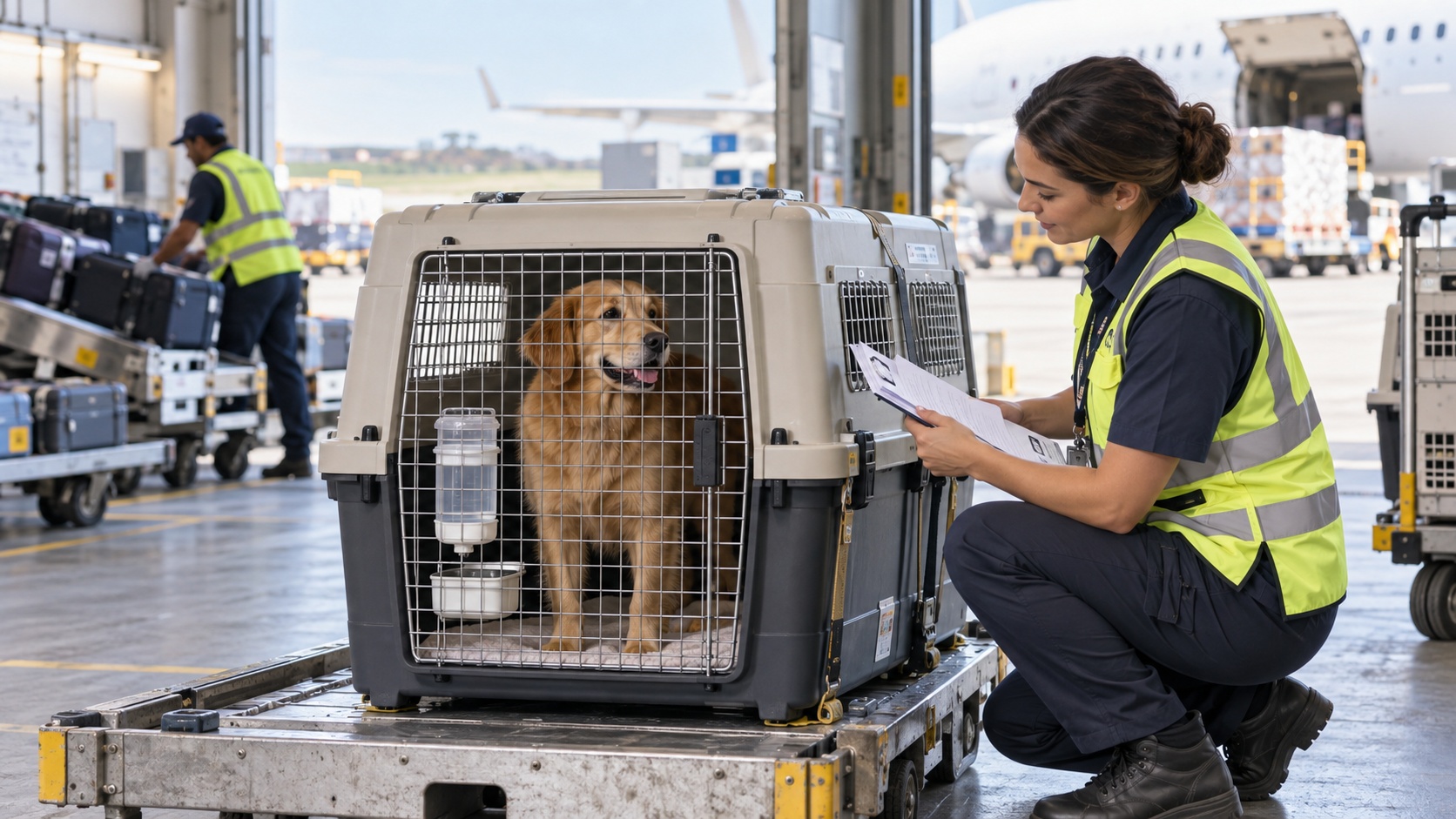
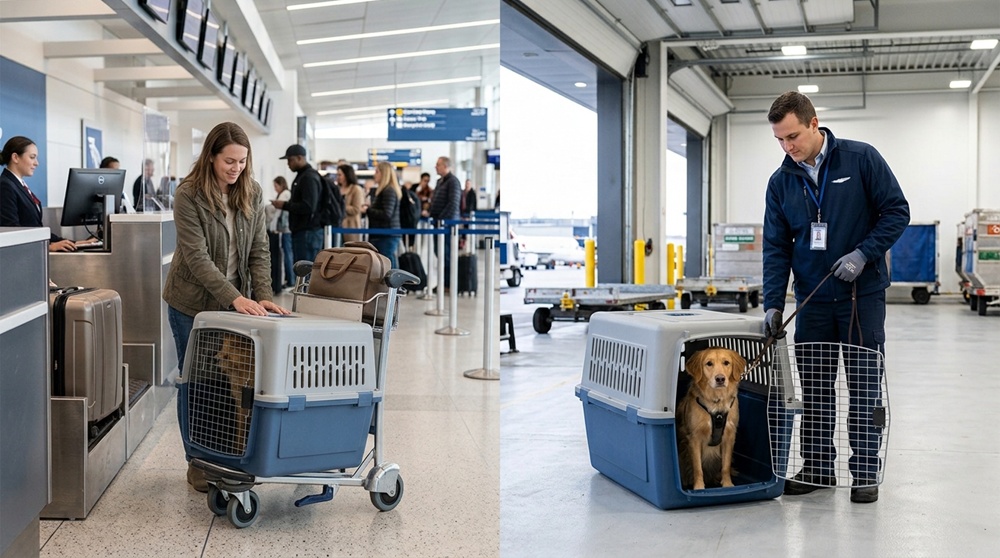
Manifest cargo is a formal live-animal cargo booking. The pet does not check in at the passenger counter as an ordinary piece of baggage. Instead, the journey is coordinated through an airline's cargo service and approved animal-handling process. This can involve:
The pet may travel on the same aircraft as the owner, but the passenger ticket and cargo booking are separate.
Cargo bookings may need to be arranged through a professional pet shipper such as Paws en route rather than directly through the airline's passenger reservations team.
Great Britain only permits pets to enter through approved transport companies and routes. Approval can depend on the specific combination of:
An airline being approved does not mean every flight it operates can transport a pet into Great Britain. Approved-route lists can change. Seasonal services may also be added, removed, or temporarily unavailable. The exact route should therefore be confirmed before the pet's cargo booking and the owner's passenger ticket are finalized.
There are approved air routes into England and Scotland. There are generally no direct approved pet air routes into Wales, so pets moving to Wales usually arrive through an approved airport in England or Scotland and continue by ground.
The United Kingdom has extensive nonstop passenger connectivity from Canada.
Depending on the Canadian departure city, destination, airline, and season, direct service may be available through carriers such as:
Other airlines or codeshare partners may appear when searching for passenger itineraries.
Common nonstop passenger destinations can include London Heathrow, London Gatwick, Manchester, Edinburgh and Glasgow. London generally has the broadest range of year-round and seasonal options. Manchester, Edinburgh, and Glasgow may have fewer routes or more seasonal schedules.
Canadian departure options may include major gateways such as Toronto, Montreal, Vancouver, Calgary and Halifax. The specific routes available vary by season and schedule year.
Paws en route generally recommends the most direct and least complicated suitable route for the pet. A nonstop route may reduce:
However, a nonstop passenger flight is only a starting point. The operating airline must also offer an approved live-animal cargo service on the route.
Air Canada, WestJet, Air Transat, British Airways, and their partners can have very different passenger and cargo capabilities. The airline that offers the most convenient passenger schedule may not be the airline that offers the best pet route. A workable pet itinerary needs to confirm:
A direct British Airways, Air Canada, WestJet, or Air Transat passenger flight does not by itself confirm that a pet can travel on the same service. Airline cargo policies are separate from passenger pet policies. A carrier that accepts a pet in cabin to another European country may still require cargo for the UK or may not offer live-animal cargo on the desired route. Before booking, confirm:
The best airport is not necessarily the airport closest to the owner's final address. It is the airport that offers the most direct workable approved route for the pet.
London Heathrow is often the first airport considered because it has extensive Canadian passenger connectivity and major cargo infrastructure.vIt may be practical for pets travelling to: London, Southern England, Central England, The Midlands, Wales or other destinations reached by ground. Owners should allow for:
The pet is not normally collected from the passenger baggage area.
London Gatwick may be relevant where an approved airline and live-animal cargo service are available. It can be useful for London, Southern England, Brighton, The south coast and some seasonal Canadian passenger routes. A passenger flight to Gatwick should not be assumed to include an approved live-animal cargo option.
Manchester can be practical for destinations in Northern England, The Midlands, Yorkshire, Liverpool and surrounding areas and North Wales. Using Manchester may reduce onward ground travel compared with arriving in London. Cargo service, route approval, aircraft suitability, and animal-reception arrangements still need to be confirmed for the exact flight.
For pets moving to Scotland, Edinburgh or Glasgow may reduce the ground journey after the transatlantic flight. These airports may be useful for travel to Edinburgh, Glasgow, Aberdeen, Dundee, Inverness, The Highlands and the Scottish island connections. Direct Canadian passenger service to Scotland may be seasonal, and live-animal cargo availability may not match the passenger schedule.
A route should only be selected after confirming that the specific airline, airport, and cargo service are approved and operating.
Sometimes the most practical approved route is through Heathrow, Gatwick, or Manchester, followed by a planned ground transfer. This may make sense when:
Paws en route evaluates the complete journey rather than selecting an airport solely because it is closest to the final destination.
Some owners consider flying a pet in cabin or as checked baggage to Dublin, Paris, Amsterdam, or another European city and then continuing to Great Britain by ground, ferry, or Eurotunnel.
This can be possible, but it is not automatically easier. It may require coordination of:
Eurostar passenger trains do not provide a simple ordinary-pet service comparable to carrying a pet in cabin on an airline. Ferry and Eurotunnel arrangements may also require the pet to travel in a vehicle.
Paws en route generally recommends the most direct and least complicated compliant route available for the pet. A continental Europe route should only be selected when it provides a genuine welfare, airline, or logistical advantage.
The Great Britain framework described in this guide applies to England, Scotland, and Wales. Northern Ireland is also part of the United Kingdom, but it follows a separate pet-travel process connected to the EU framework. Pets travelling directly from Canada to Belfast or another Northern Ireland destination may need:
The correct process can depend on whether the pet:
Do not assume that a cargo plan for London, Manchester, Edinburgh, or Glasgow can be reused for Belfast. Because the Republic of Ireland and Northern Ireland can form part of the same journey, we explain this distinction in more detail in our pet travel from Canada to Ireland guide.
Paws en route confirms the correct destination framework before the route and documentation are finalized.
Great Britain restricts certain dog types, including:
Assessment can be based on physical characteristics rather than only the breed name shown on veterinary, adoption, or registration records. A crossbreed or dog that resembles a prohibited type may therefore be affected. A prohibited dog generally cannot be brought into Great Britain unless it already has the required exemption status.
Seek advice before booking if there is any possibility that the dog could be assessed as a banned type. Airlines and cargo companies may also have separate breed restrictions, particularly for snub-nosed dogs and cats.
Avoid these common mistakes:
Paws en route helps Canadian families plan safe and compliant pet travel to the United Kingdom. Our team can help with:
Paws en route generally recommends the most direct and least complicated suitable route for the pet. The route is reviewed based on approved-route availability, airline acceptance, aircraft, kennel size, season, arrival facilities, and the pet's final destination.
Whether your destination is London, Manchester, Birmingham, Edinburgh, Glasgow, Cardiff, Belfast, or another UK community, the route should be reviewed before the owner's passenger ticket is finalized.
Tell us where your pet is travelling from, the final destination, breed, size, and preferred timeline. Paws en route can help identify the appropriate entry framework and provide a customized quote.
Ready to travel?
Our IPATA-certified pet travel specialists help manage the details, from airline booking to health certificates and import permits, for a smoother travel experience.
Get a custom quotePaws en route provides trusted support for every step of pet travel, from complex international relocations to domestic travel within Canada.