Travelling with a pet from Canada to the United States may appear straightforward, but the best way to make the journey depends on your pet’s size, species, health, recent travel history and whether you will be travelling together.
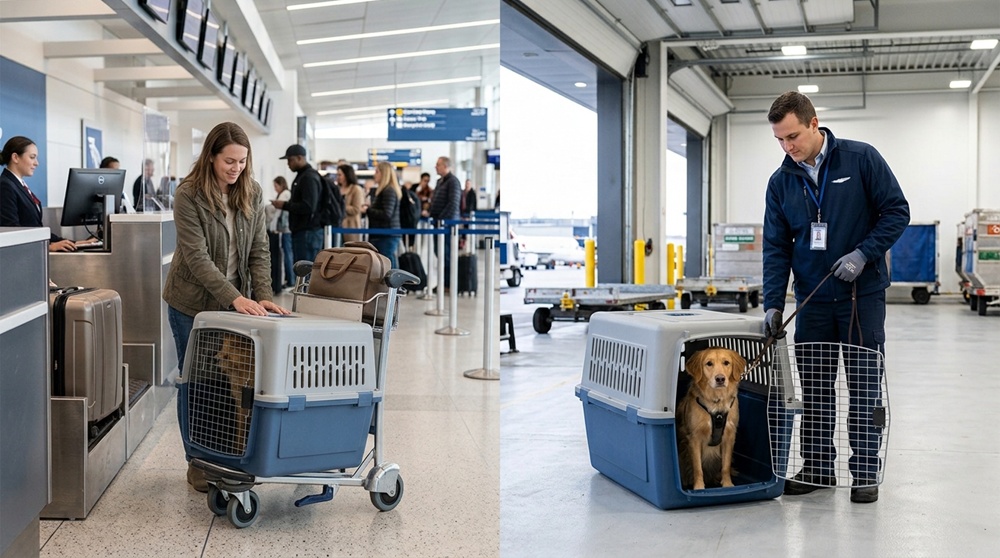
Small dogs and cats may be able to fly in the cabin with their owners. Some pets may be accepted in the aircraft’s baggage compartment when travelling on the same flight as their owner. However, the options become much more limited when a pet is too large for passenger travel or needs to fly without its owner.
Pet cargo options between Canada and the United States became significantly more limited when airlines reduced their networks during the COVID-19 pandemic beginning in 2020. Although a small number of carriers still accept pets as cargo on eligible routes, availability depends heavily on the departure airport, aircraft, kennel size, season and destination.
When a suitable Canada-origin cargo route is unavailable, another option may be to transport the pet by ground to a nearby U.S. airport and arrange the onward journey through a U.S. carrier.
Understanding the government requirements, airline policies and available route options can help you plan a safer and more workable journey.
The U.S. Centers for Disease Control and Prevention, commonly known as the CDC, introduced updated dog-entry requirements on August 1, 2024. For most dogs travelling directly from Canada, the requirements depend on where the dog has been during the six months before entering the United States.
A dog that has been only in Canada or other countries classified as dog-rabies-free or low-risk during the previous six months must generally:
The CDC Dog Import Form is completed online and is free. Although it may be submitted on the day of travel, completing it before departure can help prevent last-minute issues. The receipt may be printed or shown on a mobile device.
The receipt is generally valid for six months and may be used for multiple U.S. entries, provided the dog does not visit a high-risk country and the country of departure shown on the form remains accurate. Each dog requires its own form.
For a dog that has been only in dog-rabies-free or low-risk countries during the previous six months, the CDC does not generally require a rabies vaccination certificate as the federal entry document.
However, keeping your dog’s rabies vaccination current is still strongly recommended. An airline, destination state, veterinarian, boarding facility or other service provider may request vaccination records even when they are not required by the CDC for entry.
Government entry requirements and airline acceptance requirements are not the same. Meeting the CDC requirements does not automatically mean that an airline will accept your dog.
Different rules apply when a dog has been in a country classified by the CDC as high-risk for dog rabies during the previous six months. Additional documentation, rabies vaccination verification, veterinary endorsements and restrictions on the dog’s point of entry may apply.
A dog that recently entered Canada from another country should not automatically be treated as a dog travelling only from Canada. Its complete six-month travel history must be reviewed before the U.S. journey is planned. See the CFIA guidance on dogs travelling to the United States for more detail.
The United States Department of Agriculture does not impose a general federal animal-health import requirement on personal pet cats entering the continental United States. Cats may still be inspected at the border, and a cat that appears unwell could be referred for veterinary examination. Airlines and individual states may also have their own requirements, including:
Pet owners should check the requirements of the airline and final destination state rather than relying only on federal entry rules.
Federal entry rules are only one part of the journey. Individual U.S. states and territories may impose additional requirements for dogs and cats entering or moving within their jurisdiction. Depending on the destination, a pet may need proof of rabies vaccination, a certificate of veterinary inspection or other health documentation.
Hawaii should be treated as a separate destination because it has a much more extensive animal-entry program. Dogs and cats that do not meet Hawaii’s animal quarantine requirements may face quarantine.
The main challenge is that very few airlines now offer general pet cargo service originating in Canada. Although there are frequent passenger flights between Canadian and U.S. cities, many major airlines either do not accept pet cargo from Canada or limit the service to specific customers, airports and routes. Today, WestJet Cargo provides the clearest Canada-to-U.S. pet cargo option across eligible parts of its network, while Alaska Air Cargo offers a more regional option from Vancouver.
Other major U.S. airlines may transport pets within the United States but not accept shipments beginning in Canada. American Airlines Cargo, for example, does not transport animals outbound from Canada, while Delta currently limits pet shipping to qualifying U.S. military and State Department relocations.
Air Canada may accept eligible pets in the baggage compartment when they travel on the same flight as their owner. However, that is different from manifest cargo for a pet travelling separately, and cargo availability must be confirmed for the specific journey. Even when an airline offers pet cargo, acceptance still depends on:
As a result, a passenger flight shown between two cities may not provide a workable cargo route for a pet.
When a suitable Canada-origin pet cargo route is unavailable, a combined ground-and-air journey may offer another solution. Paws en route can arrange ground transportation from Canada through an appropriate land border and onward to a U.S. airport. Once the pet has legally entered the United States, Paws en route can coordinate an onward flight through an eligible U.S. carrier or pet cargo network. Depending on the pet’s starting point and destination, possible airport areas may include:
The airport closest to the border is not always the best airport for the journey. The selected airport must have:
For example, a smaller border airport may provide convenient passenger flights but no suitable live-animal cargo service. A larger hub farther away may provide a more reliable option.
A typical journey may include:
This type of route may be especially helpful for large dogs, unaccompanied pets and journeys for which direct pet cargo service from Canada is unavailable.
A veterinary health certificate may not be required for the pet’s land-border entry into the United States, but it may still be required for the onward flight.
If Paws en route transports a pet across the border and then arranges a domestic U.S. cargo flight, the airline may require a health certificate issued within a specific period before departure. The destination state, receiving facility or other service provider may also request additional records. Depending on the journey, required documents may include:
Paws en route reviews the border-entry and airline requirements separately so the pet has the documentation needed for each stage of the journey.
The U.S. entry requirements for many Canadian pets are manageable, but arranging the transportation can become complicated when the pet is large, travelling separately from its owner or unable to fly directly from Canada. Paws en route can help coordinate:
Every pet journey is different. The best route will depend on your pet, departure city, final destination, timing and the airline services available when you travel. International pet travel is more than booking a flight. Read Why International Pet Travel Is More Than Just Booking a Flight.
Planning pet travel from Canada to the United States? Request a custom pet travel quote and let Paws en route help identify a safe and workable route for your pet.
Pet-entry requirements and airline policies can change. All requirements and transportation options should be confirmed with the applicable government authorities, airline and pet travel specialists before departure.
Ready to travel?
Our IPATA-certified pet travel specialists help manage the details, from airline booking to health certificates and import permits, for a smoother travel experience.
Get a custom quotePaws en route provides trusted support for every step of pet travel, from complex international relocations to domestic travel within Canada.