Moving to Italy with your dog or cat? Whether your destination is Rome, Milan, Florence, Naples, Bologna, Venice, Tuscany, Sicily, or a smaller Italian town, pet travel from Canada to Italy takes more planning than booking a flight and visiting your veterinarian.
Italy follows European Union pet entry rules for dogs, cats, and ferrets. Canadian pets must meet EU documentation requirements, receive CFIA-endorsed export paperwork before leaving Canada, and travel with an airline that accepts pets on the exact route.
Italy also has a practical planning layer that many pet owners overlook: where your pet lands may not be where the journey ends. Many families arrive through Rome or Milan and then continue by car, train, private ground transportation, or a domestic flight to another part of Italy.
Recent changes to Italian aviation policy may create an additional option for some larger dogs travelling within Italy. Italy has approved guidelines allowing authorized airlines to carry pets weighing up to30 kg in the cabin on domestic flights, and ITA Airways has announced a Large Pet Friendly service for selected domestic routes. This does not apply to international flights from Canada, and availability should be confirmed for the exact domestic flight.
This guide explains what Canadian pet owners need to know before travelling to Italy with a dog or cat.
For most non-commercial pet moves from Canada to Italy, your pet will generally need:
For most Canadian families, the travelling pet will be a dog or cat. Ferrets are included because they fall under the same EU companion-animal framework. Other animals may be able to travel to Italy, but they may follow different rules and should be reviewed separately.

Before choosing a flight, confirm your pet’s identification and vaccination timeline.
Your veterinarian should scan your pet’s microchip and review the rabies vaccination record early in the process. The microchip number must match the number shown on the vaccination record, animal health certificate, and supporting veterinary documents.
The rabies vaccination must be administered after the microchip is implanted or after the microchip has been read and recorded. If the rabies vaccination predates the documented microchip identification, it may not be accepted for EU entry.
Fora primary rabies vaccination, the EU generally requires at least 21 days to pass before the vaccination becomes valid for travel.
Your rabies record should clearly show:
A rabies antibody titre test is not usually required for a pet travelling directly from Canada to Italy under standard EU rules. However, your pet’s recent travel history or transit through another country can affect the requirements.
Canadian pets travelling to Italy for the first time usually do not travel on an EU pet passport. Instead, they generally need the correct EU animal health certificate, completed in Canada and endorsed by the Canadian Food Inspection Agency before departure.
An EU pet passport is normally issued by an authorized veterinarian within the European Union. It may be useful after your pet is already living in Italy for future travel within the EU, provided the identification and rabies vaccination information remains valid.
For the Canada-to-Italy journey, begin with the EU animal health certificate and CFIA endorsement process, not an EU pet passport.

The EU animal health certificate must be completed accurately and endorsed by CFIA before your pet leaves Canada. Build in time for:
Small errors can cause major problems. A wrong microchip number, missing vaccination detail, incorrect certificate version, or missed endorsement timeline can delay or disrupt your pet’s journey.
Because Italy’s official language is Italian, confirm that the appropriate language version of the certificate is being used if Italy is your pet’s first EU point of entry.
For a pet’s movement to qualify as non-commercial, it must be linked to the owner’s movement. Your pet must generally travel with you or with an authorized person within five days before or after your travel. If an authorized person accompanies the pet, written authorization may be required.
A move may not qualify as non-commercial if:
Different commercial movement requirements may apply in these situations.
Rome Fiumicino and Milan Malpensa are often the main arrival airports considered for Canada-to-Italy pet travel. Rome can be practical for pets travelling to:
Milan may be more practical for:
Venice, Bologna, Naples, and other airports may also be useful in some cases. However, smaller airports can mean fewer pet-friendly flights, more seasonal schedules, or more complicated connections.
When choosing an arrival airport, consider:
For some pets, arriving in Rome or Milan and continuing by ground is safer and simpler than adding another flight.
Small dogs and cats may be able to travel in cabin if the airline permits it and the pet fits comfortably in an approved carrier under the seat.
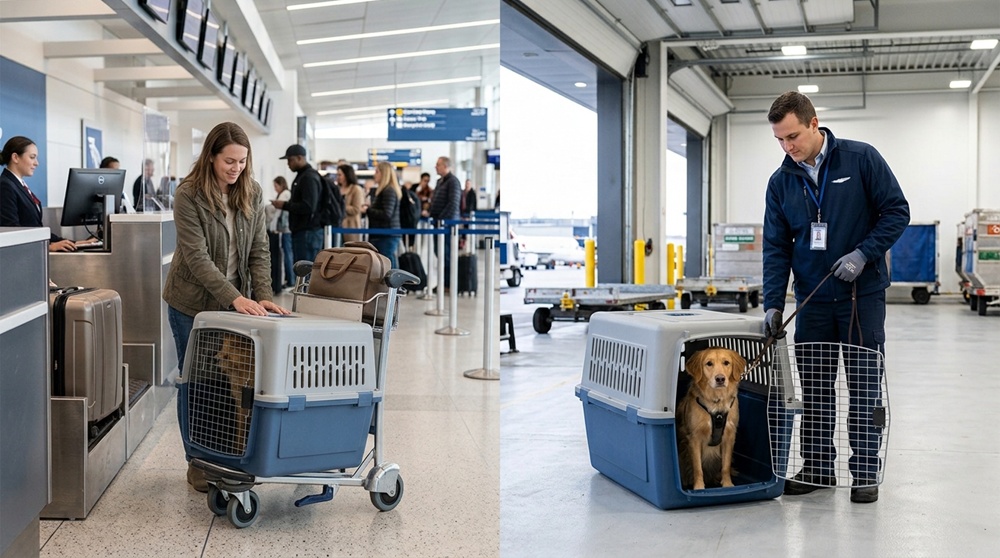
Larger pets travelling from Canada to Italy usually need to travel as checked baggage or cargo, depending on the airline, aircraft, route, season, and pet’s size.
For larger dogs, snub-nosed breeds, senior pets, anxious pets, or pets travelling during hot summer months, the route and travel method should be reviewed carefully.
Not sure which option applies to your pet? Read our guide to the 3 types of international pet air travel .
Italy has approved aviation guidelines that allow authorized airlines to carry pets weighing up to 30 kg in the passenger cabin on domestic Italian flights.
ITA Airways has announced a special Large Pet Friendly service for selected domestic scheduled flights. The service is intended to allow eligible medium and large pets to travel in a dedicated cabin space instead of the aircraft hold.
This is an important development for families continuing from Rome or Milan to another Italian city, but there are several limitations:
ITA’s current general pet policy still lists a standard maximum combined pet-and-carrier weight of 12 kg on domestic flights and 8 kg on other flights. Until the Large Pet Friendly service is clearly available for the selected itinerary, owners should not assume that a larger pet will be accepted in the cabin.
For some families, the new service may make a domestic connection more practical. For others, a private ground transfer from Rome or Milan may remain the more predictable option.
Airline rules change frequently. Pet acceptance can depend on route, aircraft, season, pet size, breed, carrier dimensions, and the operating airline.
Always confirm the exact flight before booking.
Air Canada
Air Canada may be relevant for travel from Canada to Italy depending on the route and season.
Small cats and dogs may be accepted in cabin if they meet the airline’s carrier and size requirements. Larger pets may need to travel in the baggage compartment or through cargo, depending on the pet, aircraft, route, and travel date.
Pets must be registered in advance, and space is limited.
ITA Airways
ITA Airways may be relevant for international travel to Italy and for onward domestic connections.
Under ITA’s standard published policy, eligible dogs and cats can travel in cabin when they meet the airline’s age, weight, carrier, and route requirements. ITA currently lists a maximum combined weight of 12 kg on domestic flights and 8 kg on other flights under its regular cabin-pet policy.
ITA has also announced the Large Pet Friendly service for pets up to 30 kg on selected domestic Italian flights. This special service does not apply to the Canada-to-Italy portion of the trip and must be confirmed separately for the domestic segment.
European connections
Some Canada-to-Italy journeys connect through Paris, Amsterdam, Frankfurt, Munich, Zurich, or another European hub.
These itineraries may work well, but they add another layer of planning. The first EU point of entry can affect where document and identity checks occur and which certificate language version is needed.
Mixed-airline itineraries can also be difficult because each operating airline must accept the pet and permit the transfer.
For pets, a direct flight or carefully planned single connection is usually preferable to a lower-cost itinerary with multiple handoffs.
Italy is a destination where the arrival airport is often only the first part of the move.
A family relocating to Florence, Siena, Verona, Parma, Lecce, Sorrento, Sicily, or a smaller town may arrive through Rome or Milan and then continue by car, train, or domestic flight.
Italy’s new framework for larger pets in the cabin may create another domestic-flight option for some families. However, owners should not assume that every flight or route offers the service.
When planning the onward journey, consider:
Italy’s older city centres can also create practical challenges. Narrow streets, limited parking, walk-up apartments, and busy railway stations can make it harder to manage a tired pet, luggage, and paperwork at the same time.
For some journeys, a domestic connection may be practical. For others, arriving in Rome or Milan and continuing by ground may be simpler and more comfortable.
The right carrier or crate can determine whether your pet is accepted for travel.
Small pets travelling in cabin generally need a soft-sided carrier that fits under the seat. Pets travelling as checked baggage or cargo normally need a rigid airline-approved crate.
Your pet should be able to:
For larger dogs, crate sizing should be completed early. A crate that is too small can result in denied travel.
Read our guide to pet travel crate measurements before purchasing a kennel.
The paperwork is only one part of pet travel. Your pet also needs to be physically and emotionally prepared.
Start crate or carrier familiarization well before departure. Let your pet explore the carrier at home, offer treats or meals nearby, and gradually increase the time your pet spends inside.
Speak with your veterinarian about:
For more practical advice, read Preparing Your Pet for Air Travel: 5 Tips for a Smoother Journey .
Avoid these common pet travel mistakes:
Paws en route helps Canadian families plan safe, compliant international pet travel, including moves to Italy. Our team can help with:
International pet travel is more than booking a flight. Learn more about why international pet travel requires careful planning .
Whether your pet is travelling to Rome, Milan, Florence, Naples, Bologna, Venice, Tuscany, Sicily, or another Italian destination, early planning can help avoid delays and reduce stress.
Tell us where your pet is travelling from, where they are going, their breed, size, and ideal timeline. Paws en route can help you understand the next steps and provide a customized quote for your pet’s move to Italy.
Ready to travel?
Our IPATA-certified pet travel specialists help manage the details, from airline booking to health certificates and import permits, for a smoother travel experience.
Get a custom quotePaws en route provides trusted support for every step of pet travel, from complex international relocations to domestic travel within Canada.