Moving from Canada to Switzerland with your dog or cat requires coordination between Swiss entry rules, Canadian export documentation, airline pet policies, customs procedures and transportation after arrival.
Although Switzerland is not part of the European Union, its requirements for the non-commercial movement of dogs, cats and ferrets are closely aligned with the EU pet-travel framework. For most pets travelling directly from Canada, the process begins with a readable microchip, a valid rabies vaccination, the correct animal health certificate and CFIA endorsement before departure.
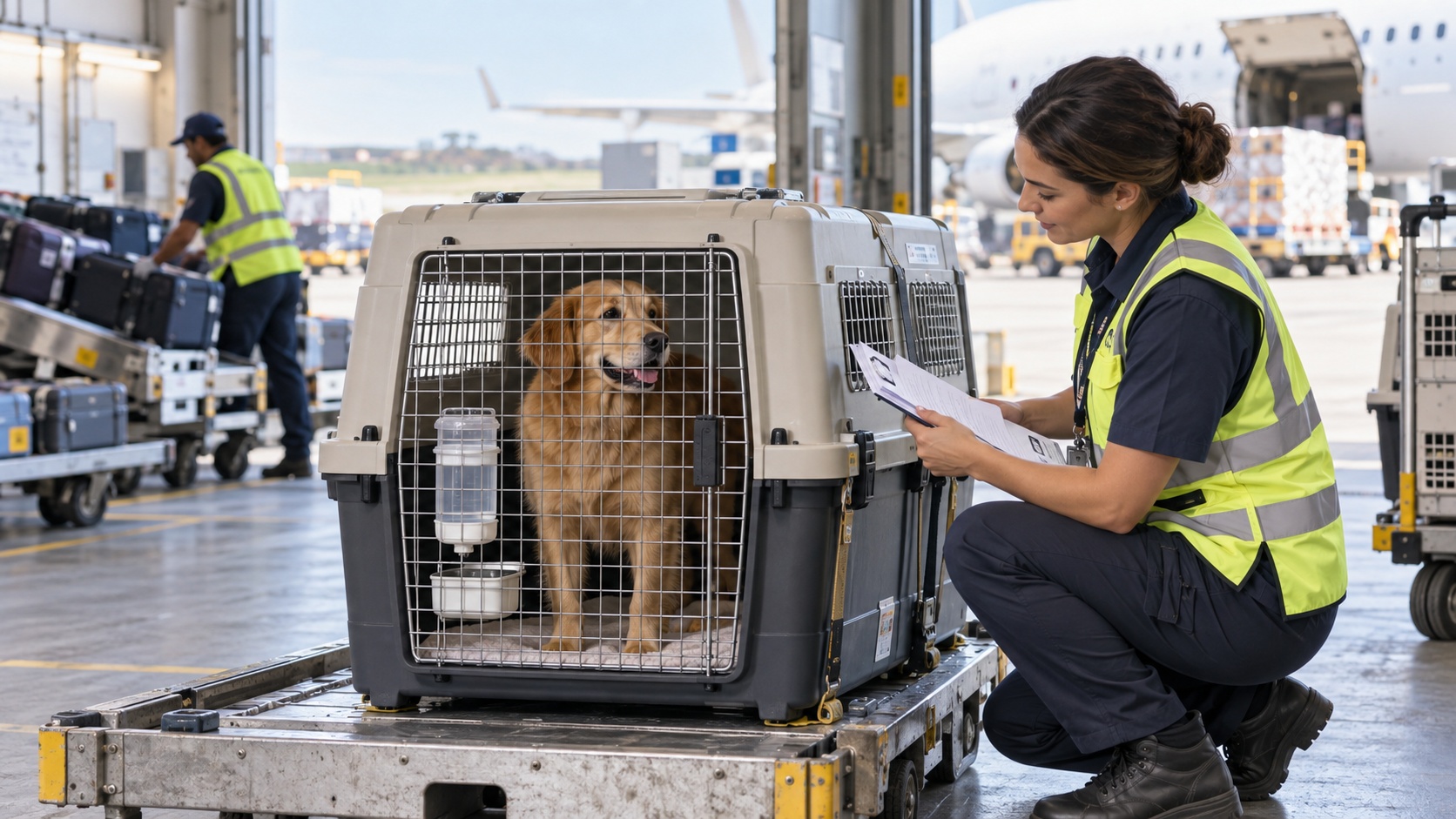
The practical journey can still vary significantly depending on the pet’s size, breed, travel kennel, departure city, airline, aircraft, route and final destination in Switzerland. A small cat travelling in the cabin from Toronto to Zurich may require a very different plan from a large dog travelling in a rigid kennel from Calgary to Geneva.
Paws en route helps Canadian pet owners understand the requirements and identify the safest, most practical route for their pet.
Switzerland has many requirements in common with nearby European destinations, but several points deserve particular attention:
For a broader explanation of requirements shared across European destinations, read our guide to moving to Europe with your pet from Canada.
For most non-commercial travel involving a dog, cat or ferret travelling directly from Canada to Switzerland, the pet will generally need:
Canada is currently treated as a lower-rabies-risk country under the applicable Swiss entry framework. A rabies antibody titre test is therefore not normally required for an ordinary dog, cat or ferret travelling directly from Canada.
However, the pet’s recent travel history and flight itinerary matter. A stay in or transit through a higher-rabies-risk country can create additional testing, documentation or routing requirements.
Your pet must be identified with a readable microchip. The microchip should be implanted, or already present and officially read, before the rabies vaccination used for travel is administered. The same microchip number must appear consistently across the vaccination record, health certificate and supporting documents.
Ask your veterinarian to scan the microchip early in the planning process. This confirms that it can be read and allows time to correct any discrepancy before the final veterinary appointment.
An unreadable microchip, missing digit or mismatch between documents can cause problems at check-in, during CFIA endorsement or upon arrival in Switzerland.
The rabies vaccination used for entry must have been administered after the pet was microchipped or the existing chip was read and verified.
Following a primary rabies vaccination, the pet must generally wait at least 21 days before entering Switzerland. The day the vaccine is administered is treated as day zero.
A booster may not require a new waiting period when it is administered before the previous vaccination expires and the vaccination history remains continuous. If a booster is given after the earlier vaccination has lapsed, it may be treated as a new primary vaccination and a new waiting period may apply.
Do not assume that every rabies vaccination is valid for international travel simply because the pet is considered vaccinated in Canada. The sequence of the microchip and vaccination, the vaccine’s validity and the details recorded by the veterinarian all matter.
A rabies antibody titre test is not normally required for a pet travelling directly from Canada to Switzerland under the standard lower-risk-country process.
Additional rabies testing may become relevant when a pet comes from or travels through a country classified as presenting a higher rabies risk. In those situations, the blood sample, laboratory result and waiting period must follow a much longer process.
A connection at an international airport does not always mean the pet has formally entered that country, but transit conditions vary. The full route should be reviewed before assuming that a stop in another country will not affect the requirements.
A dog, cat or ferret travelling from Canada to Switzerland for the first time will usually need the current non-commercial animal health certificate completed by a Canadian veterinarian. The certificate generally records:
The completed certificate must then be endorsed by the Canadian Food Inspection Agency before the pet leaves Canada. CFIA cannot endorse the certificate after the animal has departed.
The certificate is generally valid for entry checks for 10 days from the date it is issued. The veterinary appointment and CFIA endorsement therefore need to be scheduled close enough to departure that the documentation remains valid when the pet reaches its entry point. The certificate, owner’s itinerary, pet booking, destination and travel dates should all be consistent.
A Canadian pet travelling to Switzerland for the first time will usually use an endorsed animal health certificate rather than a pet passport.
A valid Swiss or EU pet passport may be accepted when the pet already holds one and continues to meet the relevant identification and vaccination requirements. This is more common for pets that previously lived in Switzerland or the European Union.
A pet passport is not normally obtained in Canada for the original journey. After relocating, an authorized veterinarian in Switzerland may be able to issue the appropriate passport for future eligible travel.
The standard process described in this guide applies to non-commercial pet travel. The pet may travel:
When the pet and owner travel separately, their journeys generally need to take place within five days of each other. Written authorization and evidence of the owner’s travel may be required.
The standard non-commercial rules generally cover no more than five dogs, cats or ferrets, subject to limited exceptions for certain competitions, exhibitions or sporting events.
A different process may apply when:
These situations should be identified before documentation and flights are arranged.
Direct flights can reduce total travel time, airport handling and the risks associated with transfers. For that reason, Paws en route generally prioritizes a direct itinerary whenever a suitable pet-friendly flight is available.
Air Canada operates direct service between Toronto and Zurich. SWISS and other SWISS Group-operated flights provide direct service from select Canadian cities, including Toronto, Montreal and Vancouver, depending on the season and current schedule.
Some flights marketed under the SWISS name may be operated by another airline within the Lufthansa Group, such as Edelweiss. The operating carrier is important because that airline’s rules determine whether the pet is accepted, how the pet may travel and which restrictions apply.
Direct service may not operate daily or year-round. Availability should be checked for the actual travel date before the owner’s ticket is finalized.
Travellers departing from other Canadian cities may need to connect through Toronto, Montreal, Vancouver or a European hub. Connecting itineraries may involve Air Canada, Lufthansa, KLM or another partner airline.
Each additional flight can introduce a different aircraft, pet policy, kennel restriction and handling process. Paws en route reviews the complete itinerary and generally recommends the most direct, practical route available for the pet.
The existence of a nonstop passenger flight does not mean that every pet can travel on it. Pet acceptance can depend on:
One direct flight may accept a small dog or cat but not have the capacity for a large rigid kennel. Another flight may use an aircraft with different hold limitations.
Pet acceptance should be confirmed on the exact flight before committing to the passenger itinerary.
Some Canada-to-Switzerland itineraries connect through Frankfurt, Munich, Amsterdam, Paris or another European airport.
When a pet first lands in the European Union before continuing to Switzerland, the first EU airport may become the point where the pet’s documents and identity must be checked. The airport must be able to process the pet’s method of entry and the onward journey must be permitted. A connection can also introduce:
A connection that appears simple for a passenger may be difficult or unavailable for a pet. When a direct flight is not workable, a carefully planned single connection is usually preferable to a multi-airline itinerary involving several handoffs.
Pets entering Switzerland directly from Canada are subject to a mandatory entry control. For directly accompanied air travel, dogs, cats and ferrets can generally enter through:
On arrival, the owner or authorized person should proceed through the red customs exit and declare the pet. All original documents should remain immediately accessible. These may include:
Do not pack the only original documents in checked luggage or attach them exclusively to the kennel. Missing or incorrect documents can result in delays, additional examination, refusal of entry or other action by the authorities.
Some pets fly into a neighbouring country and continue to Switzerland by road.
For example, a family moving to western Switzerland may consider arriving through France, while a family moving to northern Switzerland may look at an arrival through Germany. This can sometimes provide more airline or ground-transportation options, but it does not remove the need to comply with the appropriate entry process.
When the pet first enters the European Union, the document and identity check may need to occur at the first EU arrival airport. The pet must then meet the requirements for onward movement into Switzerland.
The complete route should be planned as one journey rather than treating the flight and road transfer as separate arrangements.
Zurich, Geneva and Basel provide access to much of Switzerland, but the most suitable arrival airport depends on the final address and the pet’s route. Common onward destinations include:
Switzerland has an extensive rail network, but public transportation may not be the easiest option immediately after an international flight, especially when travelling with a large kennel, multiple pets or significant luggage.
A prearranged pet-friendly ground transfer can help:
The kennel must fit both the aircraft and the vehicle used after arrival.
A dog being permanently imported into Switzerland generally needs to be registered in the Swiss dog database after arrival.
The owner should arrange an appointment with a Swiss veterinarian shortly after the move. The veterinarian can verify the microchip, review the import records and complete the required registration. This generally needs to happen within 10 days of importing the dog.
Dog ownership requirements can also vary by canton and municipality. Depending on the new address, owners may need to review:
These post-arrival obligations are separate from the federal requirements for bringing the dog into Switzerland.
Some pets require additional review before travel.
Switzerland has restrictions related to the importation of dogs with cropped ears or docked tails. Owners should not assume that a dog can enter under the ordinary pet-travel process simply because the procedure was legal where it occurred.
The dog’s history, reason for the procedure and intended type of entry may need to be reviewed with Swiss authorities before travel.
Switzerland does not apply one simple nationwide import rule covering every breed. However, individual cantons may regulate the ownership or keeping of certain dogs.
A dog may be permitted to enter Switzerland federally but still be subject to registration, authorization, training, leash, muzzle or ownership rules in the destination canton.
Animals that are hybrids, exotic species or protected under the Convention on International Trade in Endangered Species may require additional permits or documentation.
The standard dog-and-cat process should not be assumed to apply to every animal described as a pet.
Avoid these common mistakes:
Paws en route helps Canadian families plan safe and compliant pet travel to Switzerland.
Our team can help:
Paws en route generally recommends the most direct and least complicated suitable journey, based on the pet’s size, breed, kennel, airline acceptance, aircraft, season, arrival process and final destination.
International pet travel involves much more than purchasing a passenger ticket. Read Why International Pet Travel Is More Than Booking a Flight.
Whether you are travelling to Zurich, Geneva, Basel, Bern, Lausanne, Lucerne, Lugano or another Swiss destination, early planning can help prevent documentation, airline and arrival problems.
Tell us where your pet is departing from, the final destination, breed, size and preferred travel dates. Paws en route can review the journey and provide a customized pet-travel quote.
Ready to travel?
Our IPATA-certified pet travel specialists help manage the details, from airline booking to health certificates and import permits, for a smoother travel experience.
Get a custom quotePaws en route provides trusted support for every step of pet travel, from complex international relocations to domestic travel within Canada.