

Planning pet travel from Canada to Europe can feel overwhelming. Even when destinations share similar entry rules, the actual process can vary depending on the country, airline, route, pet size, breed, kennel, season, and final address.
For many European destinations, the journey starts with the same core requirements: a microchip, rabies vaccination, health certificate, government endorsement, airline approval, and a suitable travel carrier or kennel. But once those requirements are applied to a real trip, the details can change quickly.
A pet travelling from Canada to France, Germany, Italy, Spain, Portugal, the Netherlands, Switzerland, Ireland, or the United Kingdom may need different documents, airline handling, arrival checks, routing decisions, or ground transportation plans.
Paws en route helps Canadian pet owners understand what is required and plan the safest, most practical route for the pet.
Table of Contents
Use these country guides to review destination-specific requirements, direct flight considerations, airline rules, arrival planning, and common mistakes.
If you are not sure which guide applies, start with the pet's final destination. For example, Dublin and Belfast are not handled the same way. Pets travelling to the Republic of Ireland follow Ireland's process, while pets travelling to Northern Ireland follow a separate UK-related process.
"Europe" is often treated as one destination, but pet travel rules are not the same across the continent.
Many destinations, including France, Germany, Italy, Spain, Portugal, the Netherlands, and Ireland, follow the European Union pet-entry framework for dogs, cats, and ferrets travelling from Canada. This framework generally covers identification, rabies vaccination, an animal health certificate, non-commercial movement rules, and entry through a traveller point of entry.
However, some destinations have additional requirements.
Ireland follows the EU framework but generally requires timed tapeworm treatment for dogs before arrival. Great Britain, which includes England, Scotland, and Wales, has a separate pet-entry process and generally requires pets arriving by air to travel as manifest cargo through an approved route. Switzerland is not part of the European Union, but it has its own pet-entry process that is closely aligned with many European requirements.
This is why the country-specific guide matters. The shared European framework is only the starting point.
For many dogs, cats, and ferrets travelling from Canada to Europe, the planning process starts with several core requirements.
These commonly include:
These requirements sound straightforward, but the details matter. A rabies vaccination may not count for travel if it was given before the microchip was implanted or read. A health certificate may need to be issued on a specific form. A pet may be eligible for one airline's route but not another. A direct passenger flight may not accept pets in the cabin, hold, or cargo.
This is why the route, documents, airline, and timing should be reviewed together.
The right planning window depends on the destination, the pet's vaccination history, how the pet will travel, and whether the itinerary includes connections or special arrival procedures. As a general guide, many families should begin planning several months before departure, especially when travelling with a large dog, using manifest cargo, or moving during a busy travel season.
Confirm the final destination and preferred travel dates. Review the destination's current entry requirements, check that the pet's microchip can be read, and compare the microchip number against the vaccination record. If the rabies vaccination was given before the microchip was implanted or read, the vaccination may need to be repeated. This is also a good time to discuss fitness to fly with your veterinarian and begin introducing the pet to its carrier or kennel.
Identify suitable flight and routing options before finalizing the owner's ticket. Confirm whether the airline can accept the pet in the cabin, as checked baggage, in the hold, or as manifest cargo, and check aircraft, breed, kennel, and seasonal restrictions. Measure the pet carefully, select the appropriate carrier or travel kennel, and begin any booking or cargo reservation process required by the airline.
If the pet needs a primary rabies vaccination, at least 21 days generally must pass between the vaccination and arrival in many European destinations. A valid booster given before the previous vaccination expires may not require a new waiting period, but complete vaccination records should be available.
Confirm the final itinerary, operating airline, pet reservation, arrival airport, and onward ground transportation. Contact the veterinarian and local CFIA office to coordinate appointments within the required certificate window. Review the correct health certificate, supporting vaccination records, owner or authorized-person declarations, and any destination-specific arrival or treatment requirements.
For many European Union destinations, the animal health certificate must be completed within 10 days of entry and then endorsed by the CFIA before departure. The exact window and certificate can differ for Great Britain, Switzerland, Northern Ireland, commercial movements, or pets travelling under different circumstances, so the destination-specific instructions should be confirmed before scheduling the appointment.
Complete any time-sensitive destination requirements. Dogs entering Ireland or Great Britain, for example, may require veterinary tapeworm treatment within a specific window before arrival. When the pet travels with an authorized person or separately from the owner, confirm that the movement remains within the permitted owner-travel window and that the required authorization and itinerary evidence are available.
Reconfirm the flight and pet booking, check for schedule or aircraft changes, and organize the original endorsed documents so they are easy to access. Verify carrier or kennel setup, labels, bowls, bedding, and airline instructions. Recheck the expected arrival time when a treatment or document is tied to the scheduled entry time.
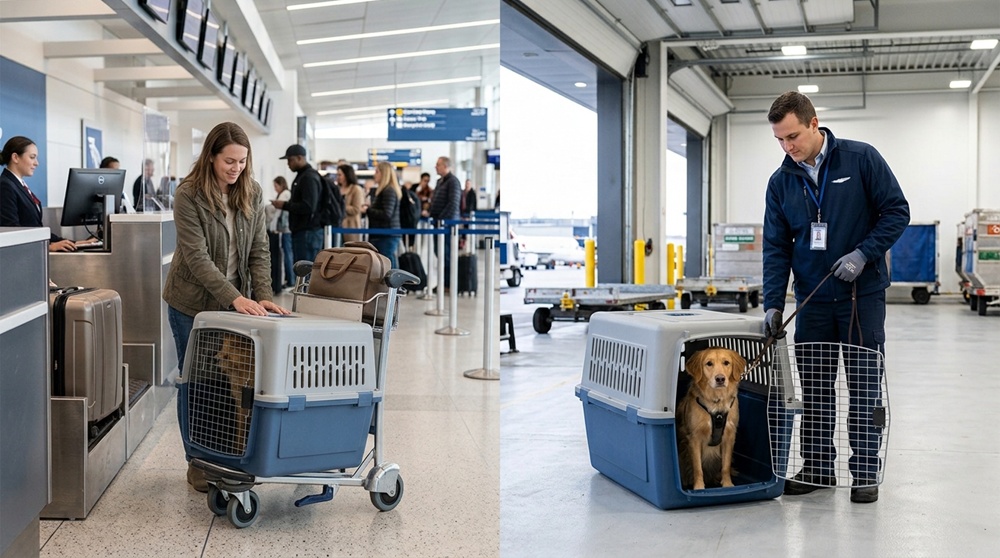
Allow additional time for airline check-in or cargo acceptance and carry the original travel documents. At the first point of entry, be prepared for the pet's microchip and documents to be checked. Keep copies of the itinerary, veterinary records, airline confirmation, and destination contacts available throughout the journey.
This timeline is a general planning guide rather than a fixed schedule. Country rules, certificate forms, airline policies, and seasonal restrictions can change, so each trip should be reviewed using the pet's actual destination, route, and travel method.
A pet travelling from Canada to many European destinations must be identified with a readable microchip.
The microchip should be implanted or read before the rabies vaccination used for travel is administered. The microchip number must match across the vaccination record, health certificate, and supporting documents.
After a primary rabies vaccination, the pet usually needs to wait at least 21 days before entering many European destinations. Some situations, such as travel history through a higher-risk country, may create additional requirements.
Ask your veterinarian to scan the microchip early in the planning process. A missing digit, unreadable chip, or mismatch between records can create problems close to departure.
Pets travelling from Canada to Europe usually need a health certificate completed by a Canadian veterinarian and endorsed by the Canadian Food Inspection Agency.
The correct certificate depends on the destination.
For many European Union destinations, pets need an EU animal health certificate. For Great Britain, pets need a Great Britain pet health certificate. For Switzerland, the required documentation should be checked against Swiss entry rules. For Northern Ireland, EU-aligned documentation may apply.
The certificate usually records pet identification, microchip number, rabies vaccination details, owner or authorized-person information, origin and destination, non-commercial movement declarations, dog tapeworm treatment where applicable, and veterinary certification.
CFIA endorsement must be completed before the pet leaves Canada. The certificate, route, airline booking, and owner travel details should all match.
A Canadian pet travelling to Europe for the first time usually needs a health certificate, not an EU pet passport.
An EU pet passport is generally issued within the European Union for eligible pets and can be useful for future travel after the pet is living in Europe. It is not usually the document used for the first trip from Canada.
For the original Canada-to-Europe journey, focus on the correct destination-specific certificate and CFIA endorsement.
Many non-commercial pet movements require the pet's travel to be linked to the owner's travel.
The pet may travel with the owner, with an authorized person acting on the owner's behalf, or separately within a permitted window, often five days before or after the owner.
If the pet is being sold, rehomed, transferred, or travelling outside the non-commercial timing rules, a different process may apply.
This is especially important when a pet travels separately from the owner, or when a family is moving in stages.
The biggest differences between European destinations usually fall into a few categories.
France, Germany, Italy, Spain, Portugal, the Netherlands, and Ireland generally follow the EU pet-entry framework for dogs, cats, and ferrets travelling from Canada.
However, the practical journey can still differ by country. The first EU point of entry, certificate language, airline, arrival airport, onward ground transportation, and local post-arrival requirements can all affect the plan.
Ireland follows the EU framework, but dogs generally require timed tapeworm treatment before arrival. Pets arriving from Canada must also enter through an appropriate traveller point of entry and complete the required compliance process.
Ireland should not be confused with Northern Ireland. If the final destination is Belfast or another Northern Ireland location, review the UK-related process instead.
Great Britain includes England, Scotland, and Wales. Pets entering Great Britain by air generally need to travel as manifest cargo through an approved route and transport company.
That makes the UK very different from many EU destinations. A pet that can travel in cabin to Dublin, Paris, Amsterdam, or Rome generally cannot enter London, Manchester, Edinburgh, or Glasgow that way.
Northern Ireland is part of the United Kingdom but follows a separate process connected to the EU framework.
Switzerland is not part of the European Union, but its pet-entry process is closely aligned with many European requirements. It should still be reviewed as its own destination rather than treated as a standard EU arrival.
Some European destinations require dogs to receive treatment against Echinococcus multilocularis before arrival.
This is not required for every European destination, but it is important for countries such as Ireland and for Great Britain.
For Ireland, dogs travelling directly from Canada generally require veterinary tapeworm treatment no less than 24 hours and no more than 120 hours before scheduled entry. The treatment must be administered by a veterinarian and recorded correctly in the travel documents.
Cats and ferrets do not require this dog tapeworm treatment.
The timing should be planned around the pet's scheduled arrival, not only the departure time from Canada. Time zones, flight delays, and connections can affect whether the treatment remains within the permitted window.
For details, see our pet travel from Canada to Ireland guide and our pet travel from Canada to the United Kingdom guide.

For many European moves, a direct flight from Canada can be the simplest option when the airline accepts the pet and the route meets the animal's needs.
Paws en route generally recommends the most direct and least complicated suitable route for the pet. A nonstop flight can reduce total travel time, limit airline handoffs, lower connection risk, and reduce the chance of conflicting pet policies between carriers.
However, a direct passenger flight does not automatically mean the pet can travel on that aircraft. The operating airline, aircraft type, pet travel method, kennel dimensions, pet weight, breed restrictions, seasonal temperature limits, arrival rules, and ground transportation plan all need to be confirmed before the owner's ticket is finalized.
A direct flight may work well for one pet and not another. A small cat may qualify for in-cabin travel on one airline, while a large dog may require a cargo booking or a different route.
European pet travel may involve different travel methods depending on the country, airline, pet, aircraft, and route.
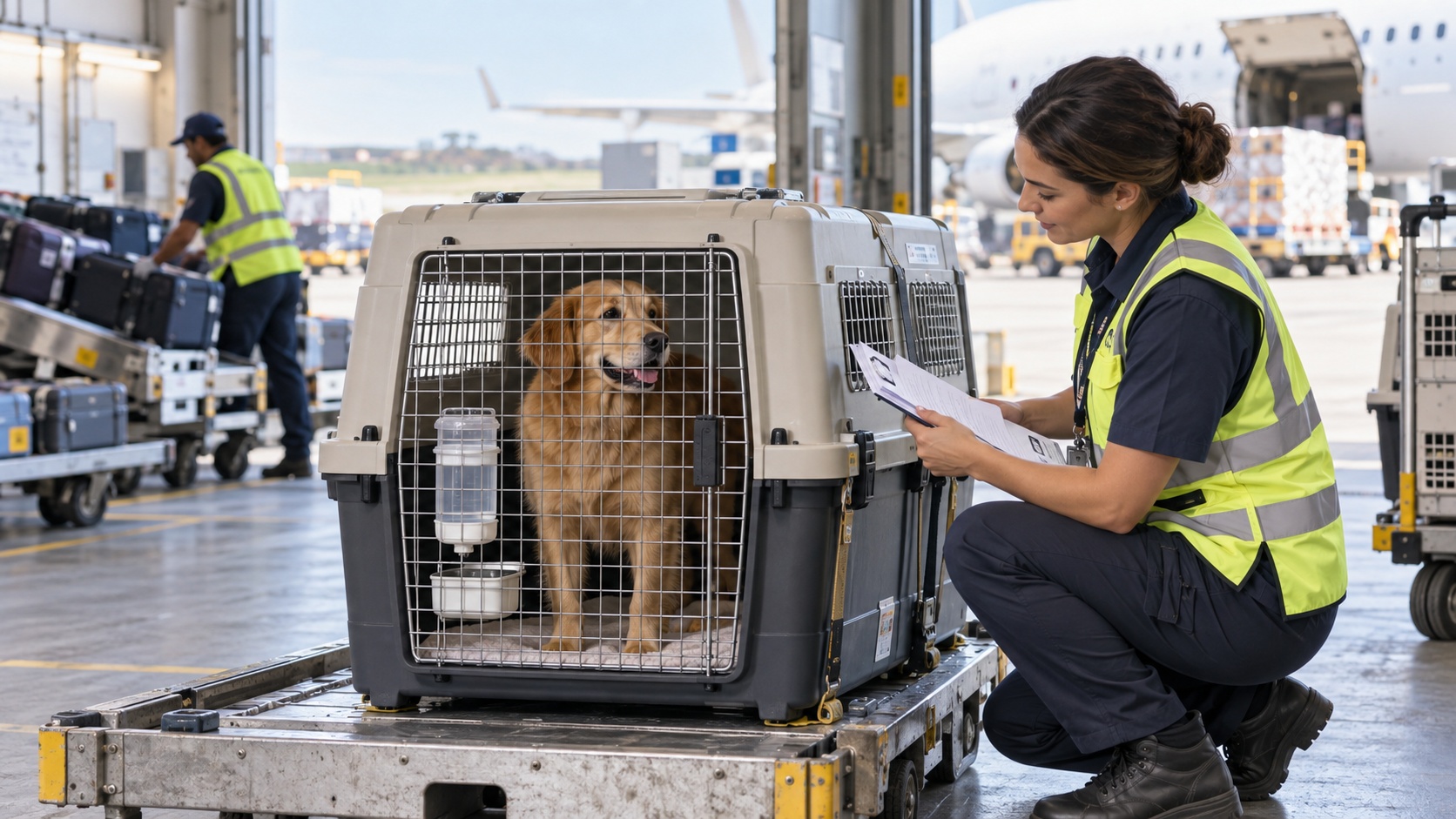
Small pets may be eligible to travel in the passenger cabin if the airline permits it and the pet fits comfortably inside an approved carrier beneath the seat. Larger pets may travel as checked baggage, in the aircraft hold, or as manifest cargo, depending on the airline's rules and the destination requirements.
Not every airline offers every option. Some airlines accept pets in cabin but not in the hold. Some accept pets as checked baggage on certain aircraft but not others. Some require cargo for large dogs, certain routes, or pets travelling separately from the owner.
Great Britain is different from many European destinations because most pets entering by air must arrive as manifest cargo through an approved route.
Read our guide to the 3 types of international pet air travel for a deeper explanation of these travel methods.
Sometimes a direct flight is not available or not suitable for the pet. In those cases, a connection may be needed.
Connections can add another airline policy, another aircraft type, additional handling, longer travel time, more temperature considerations, and a higher risk of missed connections. They can also affect where the pet first enters Europe, which may change the document language, inspection process, or transfer procedure.
When a direct flight is not workable, a carefully planned single connection is usually preferable to a multi-airline itinerary with several handoffs.
A connection through Great Britain can be especially complicated because Great Britain has separate approved-route and cargo-arrival rules. Do not assume that a pet travelling in cabin or as checked baggage to Ireland, France, or the Netherlands can connect normally through London.
The best route is not always the lowest-cost passenger ticket. Paws en route reviews the complete journey to identify the most direct workable route for the pet.
A cabin carrier must meet the airline's current requirements and fit beneath the seat. A pet travelling in the hold or as cargo needs an appropriately sized travel kennel.
The pet should be able to stand naturally without touching the top, turn around, sit comfortably, and lie down normally. Kennel size can determine which airline, aircraft, and route are possible. Large dogs may be limited to specific aircraft or cargo options.
Read our guide to pet travel crate measurements.
Start preparation well before departure.
Introduce the carrier or kennel early, build positive associations with the crate, and speak with your veterinarian about fitness to fly, feeding, hydration, anxiety, breed-specific risks, age-related concerns, medication questions, and any treatment timing that applies to the destination.
Read Preparing Your Pet for Air Travel: 5 Tips for a Smoother Journey.
Avoid these common mistakes:
Paws en route helps Canadian families plan safe and compliant pet travel to Europe.
Our team helps confirm destination-specific requirements, review the veterinary and documentation timeline, coordinate CFIA endorsement, compare direct and connecting routes, check airline pet policies, review cabin, hold, checked-baggage, and cargo options, advise on crate measurements, plan dog tapeworm treatment where required, and coordinate airport or ground transportation.
Paws en route generally recommends the most direct and least complicated suitable route for the pet, based on the pet's size, breed, kennel, airline acceptance, aircraft, season, arrival requirements, and final destination.
International pet travel is more than booking a passenger ticket. Read Why International Pet Travel Is More Than Just Booking a Flight.
Whether your pet is travelling to France, Germany, Italy, Spain, Portugal, the Netherlands, Switzerland, Ireland, the United Kingdom, or another European destination, early planning can help avoid documentation, airline, and arrival issues.
Tell us where your pet is travelling from, their final destination, breed, size, and preferred timeline. Paws en route can help identify the next steps and provide a customized quote.
Ready to travel?
Our IPATA-certified pet travel specialists help manage the details, from airline booking to health certificates and import permits, for a smoother travel experience.
Get a custom quotePaws en route provides trusted support for every step of pet travel, from complex international relocations to domestic travel within Canada.