Moving from Canada to the Netherlands with your dog or cat? Whether you are relocating to Amsterdam, Rotterdam, The Hague, Utrecht, Eindhoven, Groningen, or another Dutch community, the journey will likely be planned around Amsterdam Airport Schiphol.
The Netherlands follows the European Union framework for non-commercial travel with dogs, cats, and ferrets. This creates a familiar set of entry requirements, including a microchip, valid rabies vaccination, EU animal health certificate, and CFIA endorsement.
What makes a Netherlands move different is often the route itself. Amsterdam is well connected to Canada, but the availability of a direct passenger flight does not guarantee that the flight will work for a particular pet. Airline policies, aircraft restrictions, pet weight, kennel dimensions, breed, season, available pet space, and whether the route is operated by a Canadian or international carrier all need to be considered.
The Netherlands also requires imported dogs to be registered after arrival, making post-arrival planning another important part of the move.
This guide focuses on the practical decisions that matter most when planning pet travel from Canada to the Netherlands.
For many Canadian pet owners, the Netherlands offers useful international flight connectivity and the possibility of arriving directly at Amsterdam Schiphol.
However, pet acceptance depends on much more than whether an airline generally flies to Amsterdam. The exact aircraft, travel class, connection time, carrier or kennel size, pet weight, breed, season, and operating airline can all determine whether a route works.
Amsterdam Schiphol is the primary international gateway for most Canada-to-Netherlands pet travel. Nonstop or one-stop options may be available from major Canadian cities, depending on the airline and season. Canadian carriers such as Air Canada and Air Transat may be relevant for some itineraries, while KLM can also be relevant because Amsterdam is its home hub.
Each airline has different cabin, checked-baggage, hold, and cargo policies. Some aircraft do not accept pets in the hold, and Schiphol may also be the first EU point of entry for pets continuing elsewhere. These details should be reviewed before the owner’s flight is finalized.
For most non-commercial travel from Canada to the Netherlands, a dog, cat, or ferret will generally need a readable microchip, a valid rabies vaccination given after the microchip was implanted or read, at least 21 days after a primary rabies vaccination, the correct EU animal health certificate, CFIA endorsement before leaving Canada, and a non-commercial movement declaration.
The pet’s movement must also be connected to the owner’s travel, and the pet must arrive through an appropriate traveller point of entry.
Under the standard process, dogs, cats, and ferrets are generally at least 15 weeks old before they can enter. This reflects the minimum age for rabies vaccination and the subsequent 21-day waiting period.
The EU considers a rabies vaccination valid for entry only when the pet was identified with its microchip before the vaccination was administered. The same microchip number must appear on the vaccination certificate and health documents.
A rabies antibody titre test is not normally required when a pet travels directly from Canada under the standard requirements for listed countries. However, the pet’s recent travel history or transit through another country can change the requirements.
For a more detailed explanation of the shared European rules, see our guide to moving to Europe with your pet.
A Canadian pet travelling to the Netherlands for the first time generally needs an EU animal health certificate, not an EU pet passport.
The certificate records the pet’s microchip information, rabies vaccination, owner or authorized-person details, origin and destination, non-commercial movement declarations, and veterinary certification.
It must be completed correctly and endorsed by an official Canadian Food Inspection Agency veterinarian before the pet leaves Canada.
CFIA states that the certificate must be completed in English and in the official language of the first EU country the pet enters. If the Netherlands is the first EU point of entry, use the certificate version required for the Netherlands. If the pet first lands in another EU country, the required language may be based on that first entry country instead.
An EU pet passport may become useful after the pet is living in the Netherlands. An authorized EU veterinarian may be able to issue one for future eligible travel within Europe. It is not the primary document for the original trip from Canada.
To qualify as non-commercial movement, the pet’s journey must be linked to the owner’s journey. Under current EU and CFIA guidance:
Documentary evidence, such as the owner’s flight ticket or boarding pass, may be needed to show that the pet’s movement is connected to the owner’s travel.
If the pet travels outside the five-day window, is being rehomed, or does not otherwise qualify, a commercial certificate and different process may be required.
Schiphol is usually the most practical arrival airport for pets travelling from Canada to the Netherlands.
It provides ground access to much of the country, including Amsterdam, Haarlem, Utrecht, Rotterdam, The Hague, Leiden, Delft, Eindhoven, and Groningen.
Because the Netherlands is relatively compact and has strong ground connections, arriving at Schiphol and continuing by road is often simpler than adding another flight.
Paws en route generally recommends the most direct and least complicated suitable route for the pet. Fewer connections usually mean fewer airline handoffs, fewer policy conflicts, less time in transit, and a lower chance of missed transfers or delays.
Before selecting a route, consider whether the pet is accepted on the exact flight, which airline operates the aircraft, whether the pet travels in cabin, as checked baggage, in the hold, or as cargo, and how the arrival process will work at Schiphol. Ground transportation from Schiphol and the pet’s final destination should also be part of the route decision.
A route that works for a small cabin pet may not work for a large dog travelling in an oversized kennel.

Depending on the Canadian departure city and travel season, Amsterdam service may be available through Canadian or international airlines such as Air Canada, Air Transat, and KLM.
Paws en route does not automatically recommend one airline for every Netherlands move. A Canadian carrier may be practical when it offers a suitable route from the owner’s departure city and can accommodate the pet’s size, breed, carrier, or kennel. KLM may also be relevant because Amsterdam Schiphol is its main hub. The best option depends on the individual pet and the complete journey.
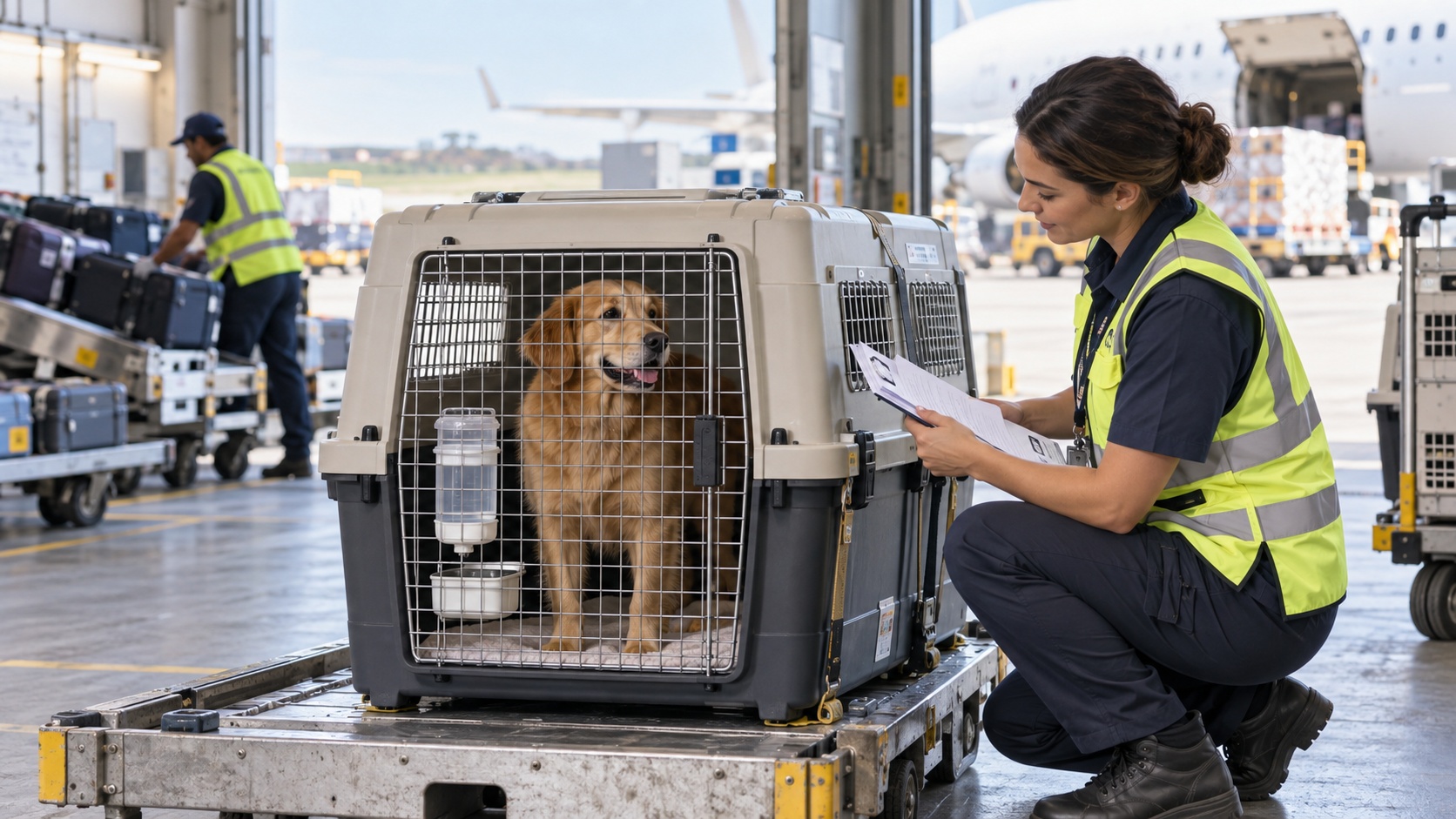
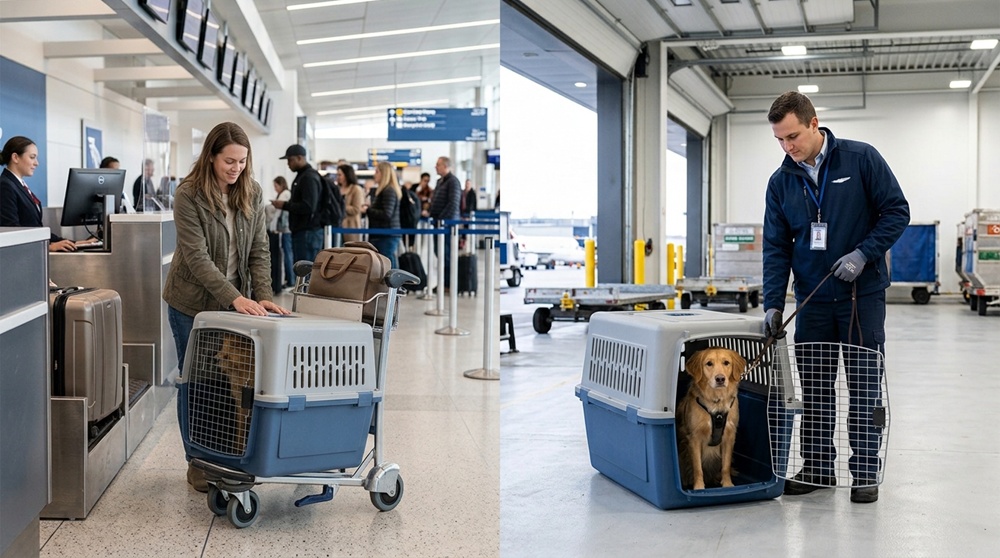
Small pets may qualify for in-cabin travel if the airline permits it and the pet fits comfortably inside an approved carrier beneath the seat. Larger pets may travel as checked baggage, in the aircraft hold, or as manifest cargo, depending on the airline, aircraft, route, season, and destination requirements.
The key point is that airline policies are not interchangeable. Air Canada, Air Transat, KLM, and other carriers may have different rules for cabin carrier dimensions, kennel size, pet weight, breed restrictions, seasonal embargoes, hold availability, aircraft restrictions, connection limits, and cargo bookings.
Aircraft matters as much as the airline name. A flight may appear suitable because it is nonstop or sold by a familiar carrier, but the scheduled aircraft may not accept pets in the hold or may not accommodate the required kennel size. Codeshares also need careful review because the operating carrier’s pet rules are usually the rules that apply.
Many airlines restrict snub-nosed dogs and cats from travelling in the aircraft hold because of increased breathing risks associated with heat and travel stress.
These restrictions can affect breeds such as bulldogs, pugs, Persian cats, and other short-nosed animals. The exact breed list and acceptance rules vary by airline. Read our guide on breed-specific tips for airline travel.
Some Canada-to-Netherlands itineraries connect through Paris, Frankfurt, Munich, Zurich, London, Dublin, or another European hub.
Paws en route generally recommends the most direct and least complicated route available for the pet. Fewer connections usually mean fewer handoffs, fewer airline-policy conflicts, less time in transit, and a lower chance of delays or missed transfers.
A connection may still be necessary depending on the Canadian departure city, pet size, kennel dimensions, airline availability, aircraft type, season, and breed restrictions.
When a direct flight is not possible, a carefully planned single connection is usually preferable to a multi-airline itinerary with several handoffs.
Connecting through another European airport can create additional considerations. The connection airport may become the pet’s first EU point of entry, the certificate language may need to match that first country, document and identity checks may happen before Amsterdam, and the pet may need to be collected and checked in again. Every operating airline must accept the pet, and the onward aircraft must accommodate the carrier or kennel.
Codeshares also need careful review. A flight sold by one airline may be operated by another, and the operating carrier’s pet rules are usually the rules that matter.
The best itinerary is therefore not always the lowest-cost passenger ticket. Paws en route reviews the complete journey to identify the most direct workable route based on airline acceptance, aircraft, travel time, connection procedures, temperature, kennel size, and destination requirements.
Keep all original pet-travel documents accessible during arrival.
These may include the EU animal health certificate, CFIA endorsement, rabies vaccination record, microchip information, non-commercial movement declaration, written authorization if someone else accompanies the pet, owner travel evidence, and airline documents.
Do not place the only original documents in checked luggage or inside the pet’s kennel.
The pet may be presented for document and identity checks. If the Netherlands is only a transit point and the final destination is elsewhere, confirm the transit and onward-entry requirements before departure.

Ground transportation should be arranged before travel day, especially for large dogs, oversized kennels, families travelling with several bags, late-night arrivals, pets needing time outside the crate, or destinations outside Amsterdam.
Although the Netherlands has an extensive rail system, public transit may not be the easiest option immediately after a long international flight.
A private pet-friendly transfer can provide more room for the kennel, reduce the number of handoffs, and take the family directly to the final address.
For pets travelling to Rotterdam, The Hague, Utrecht, Leiden, or Haarlem, a direct ground transfer from Schiphol may be more practical than complicated onward arrangements.
Paws en route can help coordinate ground transportation from Schiphol through trusted local partners, so the pet’s arrival, release timing, kennel size, and final destination are planned together.
The Netherlands requires an imported dog to be microchipped and registered within two weeks of arrival.
A Dutch veterinarian can help the owner understand the current registration process and ensure that the microchip information is connected to the new address.
This is an important post-arrival requirement and one of the main differences between the Netherlands and more general EU destination guidance.
After settling in, it is also sensible to arrange a local veterinary appointment to review the travel records, update contact information, discuss an EU pet passport for future travel, confirm local health recommendations, and understand Dutch dog ownership requirements.
Avoid these common mistakes:
Paws en route helps Canadian families plan safe and compliant pet travel to the Netherlands. Our team helps review EU and Netherlands requirements, build the veterinary and CFIA timeline, compare Canadian and international airline options, compare direct and connecting routes, check cabin, checked-baggage, hold, and cargo options, review aircraft and kennel restrictions, advise on crate measurements, coordinate airport and ground transportation, and plan the journey from Schiphol to the final destination.
Paws en route generally recommends the most direct and least complicated suitable route for the pet. The route is reviewed based on the pet’s size, breed, kennel, departure city, airline acceptance, aircraft, season, destination, and complete travel plan.
International pet travel is more than booking a passenger ticket. Read Why International Pet Travel Is More Than Just Booking a Flight.
Whether your destination is Amsterdam, Rotterdam, The Hague, Utrecht, Eindhoven, Groningen, or another Dutch community, early planning can help prevent airline and documentation problems.
Tell us where your pet is travelling from, their final destination, breed, size, and preferred timeline. Paws en route can help identify the next steps and provide a customized quote.
Ready to travel?
Our IPATA-certified pet travel specialists help manage the details, from airline booking to health certificates and import permits, for a smoother travel experience.
Get a custom quotePaws en route provides trusted support for every step of pet travel, from complex international relocations to domestic travel within Canada.